
The rumination eating disorder, also known as rumination syndrome, is a digestive and behavioral disorder. It sits at the intersection of gastrointestinal and psychiatric health. It is classified as a feeding and eating disorder in the Diagnostic and Statistical Manual of Mental Disorders (DSM-5) because the behavior is linked to learned or habitual patterns rather than a primary stomach disease.
In this disorder, recently swallowed food repeatedly returns from the stomach to the mouth and may be rechewed, reswallowed, or spit out.
Unlike vomiting, this process usually occurs without nausea, retching, or strong stomach contractions. Instead, it happens due to an unconscious behavioral reflex involving the abdominal muscles and diaphragm, which causes food to move back up shortly after eating.
The symptoms are also similar to other conditions like acid reflux or eating disorders, which could be the reason why rumination syndrome is often misdiagnosed or ignored. A lot of patients pass through years of unnecessary tests before getting the correct diagnosis.
With early diagnosis and adequate rumination syndrome treatment, the quality of life can be greatly enhanced, and complications may be avoided.
Statistics of Rumination Disorder

Though rumination syndrome used to be believed to be a rare issue, its recent discoveries indicate that rumination syndrome can be more prevalent than thought before.
A major study in the world with more than 54,000 participants in 26 countries established that rumination syndrome occurs in about 3.1 percent of adults. Further studies also suggest that the prevalence in 2023 was estimated at approximately 3.7 percent in adults and 0.4 percent in children through a meta-analysis conducted on a worldwide scale.
Moreover, certain population surveys indicate a range of prevalence between 0.8 and 10.9 percent with different populations.
Adolescent surveys have reported a prevalence of about 5 percent of rumination eating disorder among children of school-going age.
These data indicate that rumination syndrome is not a rare case but is underdiagnosed, and both patients and medical workers should be aware of it.
What Is Rumination Syndrome?

Rumination syndrome is an enteric disease that occurs as a result of swallowing food, and the food is brought back into the mouth easily after eating.
The major distinction between rumination and vomiting is that rumination is never induced by nausea or stomach infection. Rather, it is a result of involuntary actions of abdominal muscles that force the food out of the stomach.
It happens due to an unconscious behavioral reflex involving the abdominal muscles and diaphragm, which causes food to move back up shortly after eating.
Although the symptoms involve digestion, rumination eating disorder is considered primarily a behavioral or psychiatric condition because the regurgitation pattern develops as a learned response that the body repeats automatically.
Stress, anxiety, or certain psychological triggers can sometimes contribute to the development or persistence of this pattern.
The symptoms may resemble other conditions, such as Gastroesophageal Reflux Disease (GERD) or eating disorders. This is why rumination syndrome is often misdiagnosed or overlooked.
Individuals who ruminate can:
- Re-swallow the food that has been regurgitated.
- Spit it out.
- Repeated episodes follow the majority of meals.
The condition is categorized as one of the disorders of gut-brain interaction, i.e., the symptoms of the digestive tract occur under the impact of the interaction between the nervous and the digestive systems.
Rumination Disorder Causes
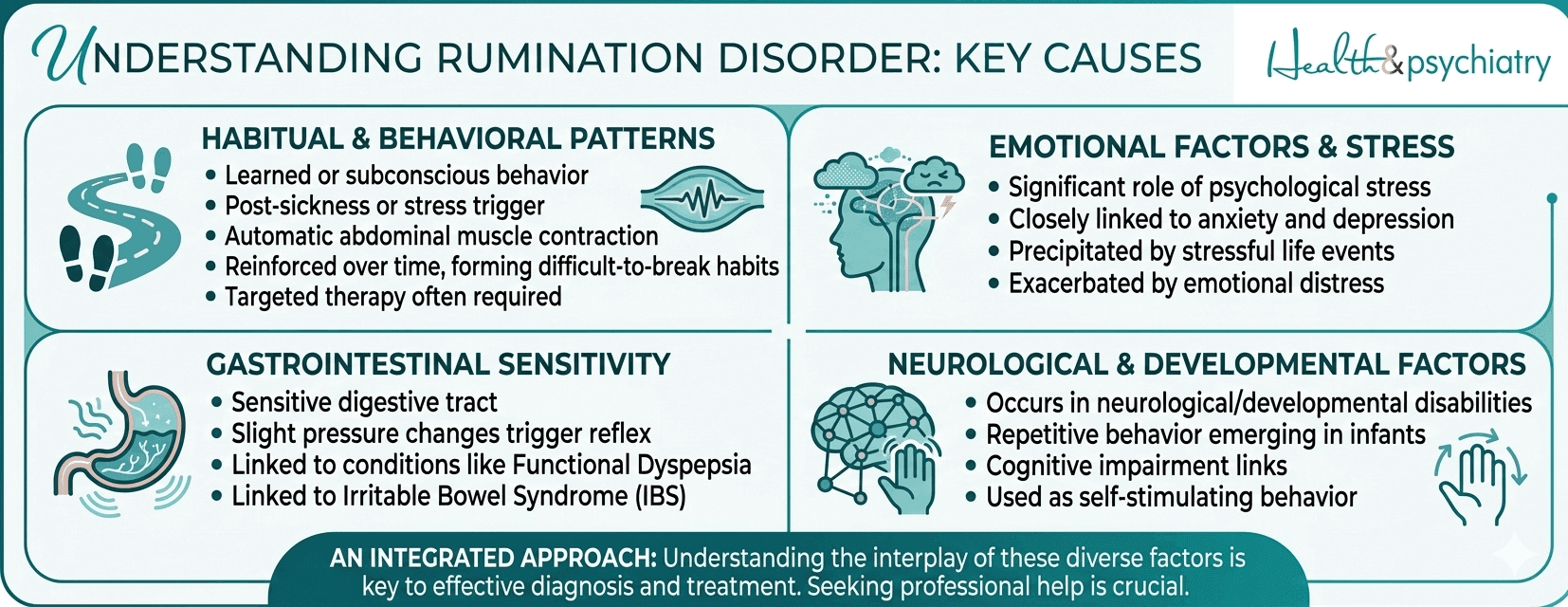
Rumination syndrome is not caused by a single cause. Rather, it tends to grow as a result of both behavioral, psychological, and physiological influences.
→ Habitual and Behavioral Patterns
Rumination is learned or subconscious in most of the instances. Once the body has experienced the first episode, say, as a result of some sickness or stress, it might acquire a habit, where, after eating, the abdominal muscles spasmodically contract automatically.
In the course of time, this trend can be hard to get rid of unless targeted therapy is applied.
→ Emotional Factors and Stress
There may be a significant role of psychological stress and emotional well-being. Research has also established rumination mental disorder to be closely related to anxiety and depression.
Symptoms can be precipitated or exacerbated by stressful life events or by emotional distress.
→ Gastrointestinal Sensitivity
There are those rumination syndrome patients who are sensitive in the digestive tract. The less significant variations in the pressure of the stomach can provoke reflexes of regurgitation more easily.
Rumination can also be seen to occur in conjunction with other digestive disorders like functional dyspepsia or irritable bowel syndrome.
→ Neurological and Developmental Factors
Rumination disorder in adults also occurs occasionally in individuals with a neurological or developmental disability. Repetitive regurgitation behaviours can emerge in infants and people with cognitive impairments as a self-stimulating behaviour.
Symptoms of Rumination Disorder

The symptoms usually appear shortly after having eaten, and may occur every day. Common symptoms include:
- Undigested food is regurgitated without any difficulty.
- Rechewing or reswallowing food.
- Regurgitating food by spitting.
- Abdominal cramping or pain.
- Bad breath.
- Weight loss in severe cases.
Due to the overlap of symptoms, patients are often misdiagnosed with such conditions as acid reflux, gastroparesis, or eating disorders.
How is Rumination Disorder Diagnosed?
Rumination disorder therapy is normally diagnosed by means of a longer medical history and symptom examination. Doctors seek certain traits, and these include:
- Regurgitation follows shortly after meals.
- Absence of nausea.
- Symptoms responding to behavioral therapies.
The diagnostic tests can involve:
- Endoscopy to exclude structural issues on the upper end.
- Esophageal manometry, to determine the muscle pressure of the digestive tract.
- pH to eliminate acid reflux.
Clinical research has shown that delay in diagnosis is frequent due to the fact that patients have been treated first of all, with reflux disease or other gastrointestinal diseases.
Rumination Disorder in Children vs. Adults
Rumination disorder can occur in any age group; however, the manifestation may vary. That is, rumination can be of the form of repetitive regurgitation following feeding in infants and young children.
Sometimes it may be associated with stress, neglect, or developmental conditions. Behavioral therapy and supportive care can help children to overcome the condition.
Similarly, rumination disorder in adults commonly occurs in adults following a triggering event, e.g., illness, surgery, or extreme stress. Loss of weight, social embarrassment, or nutritional deficiencies are also more likely to affect the adult population if the condition continues.
Treatment Options for Rumination Disorder!

Rumination disorder treatment is centered on behavioral and cognitive therapy as opposed to medication.
→ Behavioral Therapy
Behavioral therapy helps patients to be able to perceive and break the muscle contractions that cause regurgitation.
Rumination disorder therapy specialists offer treatments that will recondition digestive reactions following a meal.
→ Diaphragmatic Breathing
One of the methods of treatment for rumination disorder is diaphragmatic breathing. This method is characterized by slow breathing by the use of the diaphragm as opposed to the chest muscles.
During and after the meal, one should practice it to avoid the contractions of the abdominal muscles that lead to regurgitation.
→ Cognitive Behavior Therapy (CBT)
Cognitive behavioral therapy can be advised in the presence of stress or anxiety, amongst the symptoms. CBT enables patients to cope with emotional stimuli and develop better coping mechanisms.
→ Nutritional Support
Dietitians can assist the patients in proper nutrition, especially in case some weight has been lost.
Rumination disorder warning signs can also be controlled through the intake of small meals, slower eating, and avoidance of trigger foods.
→ Medical Monitoring
Frequent monitoring of the healthcare providers will help ensure that complications like dehydration or malnutrition are eliminated.
→ Surgery
Surgical intervention is not often necessary and is only carried out in extreme cases where other interventions have failed.
Risk Factors for Rumination Syndrome
Some causes can predispose to the development of rumination disorder, and these include:
- Anxiety or depression.
- Chronic gastrointestinal disorders.
- Developmental disabilities.
- High stress levels.
- Past gastrointestinal disease.
It has been found that those women, those with anxiety, and those with high body mass index might be at higher risk.
Complications of Untreated Rumination Disorder!

Rumination syndrome may cause a number of complications that do not include treatment, and these complications are:
- Malnutrition.
- Weight loss.
- Repeated regurgitation causes damage to the teeth.
- Eating social anxiety.
- Reduced quality of life.
Research has demonstrated that rumination syndrome in persons has poorer quality-of-life scores in both physical and mental aspects than the general population.
When to Seek Professional Help?
In case of frequent regurgitation following meals, one should seek a medical practitioner. Consult a doctor in case you experience rumination disorder symptoms:
- Persistent regurgitation.
- Unexplained weight loss.
- Difficulty eating normally.
- Symptoms affecting daily life.
With the help of early diagnosis and proper treatment of rumination disorder, the complications and the most efficient treatment can be prevented.
Living with Rumination Eating Disorder?

It is not an easy task to live with a rumination disorder; however, with an appropriate treatment plan, a lot of individuals can cope with the condition.
Breathing exercises, help, and behavioral therapy under the expert care of rumination disorder therapy provider or rumination syndrome treatment specialist usually result in great improvement.
Through adequate diagnosis and expert advice, individuals may be in a position to feel confident about eating and improve their well-being.
Struggling with Eating Disorders? Get Expert Care at Health & Psychiatry in Florida!

Looking to improve your eating habits?
At Health & Psychiatry, the team of qualified mental health experts in Florida offers high-quality evidence-based care and compassion for mental disorders, including eating disorders.
Our certified staff under the expert care of Dr. Dinar Sajan, MD. collaborates with patients to develop individualized treatment programs that not only cover physical but also psychological elements of recovery.
Take your first step towards a healthy lifestyle by booking an appointment today!
FAQs
Is rumination the same as GERD?
No. GERD (acid reflux) is a dysfunction of the esophagus in which stomach acid is returned to the esophagus. Rumination syndrome is a condition characterized by the ease with which one regurgitates undigested food with no acid reflux or nausea.
Is rumination disorder an eating disorder?
Rumination disorder is categorized as a feeding and eating disorder according to DSM-5. Although it can also be said to be a disorder of gut-brain interaction with digestion.
Is rumination disorder rare?
It was thought to be uncommon, but research indicates that there is a possibility of 3-4 percent of adults worldwide having rumination syndrome.
Can rumination disorder cause weight loss?
Yes. Regular vomiting can decrease calorie consumption, which can cause weight loss or nutritional deficiency in the case of non-treatment.