Spravato (esketamine) has come into the limelight as a novel treatment for treatment-resistant depression (TRD) and major depressive disorder with active suicidal ideation who do not respond to conventional antidepressants. This distinct action can result in quick alleviation for many patients, yet that is why one can experience Spravato side effects in a short time after taking the dosage.
Clinical evidence shows that as many as 82 percent of the patients who were treated with esketamine at extended treatment stages reported the occurrence of at least one adverse reaction, which were mostly mild to moderate in nature and resolved within the same day.
What Is Spravato (Esketamine)?
Authorized by the U.S. FDA in 2019 for adults with TRD and depressive symptoms in major depressive disorder with acute suicidal ideation, Spravato is an intranasal solution of esketamine, which is the S-enantiomer of ketamine, and unlike conventional antidepressants, its action and the action-onset are different.
It is administered only in certified medical environments under supervision, as its use may lead to some serious Spravato side effects, including dissociation and blood pressure variation.
In contrast to SSRIs or SNRIs, which can take weeks to manifest themselves in mood, Spravato can alleviate depressive symptoms in some patients in just hours, which is proven by clinical trials and real-life evidence.
Why Spravato Can Cause Side Effects?

Ketamine nasal spray side effects were most common when administering the drug on a dosing day and were usually noticed within the first hour and peaked at about 30-40 minutes of administration.
The reason behind this is many, including the following:
1. NMDA Receptor Antagonism Alters Brain Signaling
Spravato contains esketamine. Esketamine is the S-enantiomer of ketamine. It works by blocking NMDA (N-methyl-D-aspartate) receptors. This is a type of glutamate receptor in the brain. This is very different from traditional antidepressants that target serotonin or norepinephrine
Why does this matter?
→ NMDA receptors play a role in excitatory neurotransmission and brain network communication.
→ Blocking them disrupts normal glutamate signaling.
→ It temporarily alters neural circuits involved in perception, mood, and cognition.
This leads to dissociation, dizziness, distorted sensations, and cognitive changes because the brain’s processing of sensory and cognitive information is altered.
2. Glutamate & Synaptic Alterations Cause Side Effects
Esketamine increases extracellular glutamate release. It stimulates AMPA receptors as a downstream effect.
This transient increase in glutamate affects brain network activity. It alters synaptic plasticity. That may contribute to both antidepressant effects and side effects like:
- Dissociation (feeling detached from reality)
- Confusion or unusual sensory experiences
- Memory or thinking changes
These effects are caused by acute changes in excitatory neurotransmission in brain circuits that regulate perception and cognition.
3. Cardiovascular and Autonomic Effects
Spravato can increase blood pressure shortly after dosing. This is because of NMDA receptors. As they are involved in the regulation of autonomic nervous system responses.
When these receptors are blocked:
→ Sympathetic nervous activity may increase… This can temporarily raise heart rate and blood pressure.
→ Clinically, this is why patients are monitored for hypertension and related symptoms after treatment.
4. Sedation and CNS Depression
Esketamine can cause sedation, drowsiness, and slowed thinking.
Why?
Because it depresses certain central nervous system pathways. Especially at higher doses:
→ NMDA antagonism affects arousal systems in the brain.
→ Combined with its effects on other neurotransmitter systems, mental alertness and coordination can be reduced.
→ These mechanisms explain why patients are monitored for sedation and advised not to drive until the effects subside.
Common Spravato Side Effects

The side effects of Spravato are categorized into common and serious ones.
→ Common Spravato Treatment Side Effects
- Feeling of detachment
- Dizziness or vertigo
- Nausea and vomiting
- Sedation and sleepiness
- Dysgeusia
- Increased blood pressure
During the critical clinical trials, up to approximately 28 percent of the subjects dissociated, up to approximately 21- 28 percent experienced dizziness, and up to approximately 18-32 percent on the day of dosing.
In the real-world analysis on Spravato treatment, 34 per cent reported dissociation and 14 per cent experienced a rise in blood pressure, with sedation and vertigo being reported by approximately 15 per cent of the patients.
→ Serious and Less Common Spravato Treatment Side Effects
- Considerable rises in blood pressure, particularly in hypertensive patients.
- Severe sedation or the inability to remain awake.
- Uncommon cases of respiratory depression.
- Anaphylaxis, severe deterioration of the mood, or suicide ideation.
These severe long-term side effects of Spravato were not typical in randomized trials but raise the importance of medical supervision to take Spravato trials, underscoring why Spravato must be administered under medical supervision.
→ Long-Term Side Effects of Spravato (Esketamine)
Long-term or repeated exposure may carry certain risks and can lead to spravato side effects lasting longer. Particularly in susceptible individuals.
These effects are still being actively studied through post-marketing surveillance and real-world clinical data.
Potential Long-Term Side Effects Include:
1. Cognitive Changes
- Short-term memory disturbances.
- Reduced attention or slowed information processing.
2. Persistent Dissociation or Perceptual Changes
- Lingering feelings of detachment.
- Altered perception or derealization beyond the dosing window.
3. Blood Pressure Dysregulation
- Worsen pre-existing hypertension.
- Increase long-term cardiovascular risk if not adequately monitored.
4. Dependence and Misuse Potential
- Psychological dependence.
- Drug-seeking behavior in vulnerable populations.
5. Urinary Tract and Bladder Symptoms (Rare)
- Increased urinary frequency.
- Dysuria or bladder discomfort.
How Long Do Spravato Side Effects Last?
The majority of the Spravato side effects are usually short-lived and disappear within the same day, usually 1.5 to 2 hours after administration.
Most of the adverse reactions were only self-limited and lasted only hours in both clinical trials and in real-life situations, and therefore support the observation period, which must be followed after each dose in certified clinics.
→ Learn about the success rate of Spravato…
What to Expect During a Spravato Treatment Session?
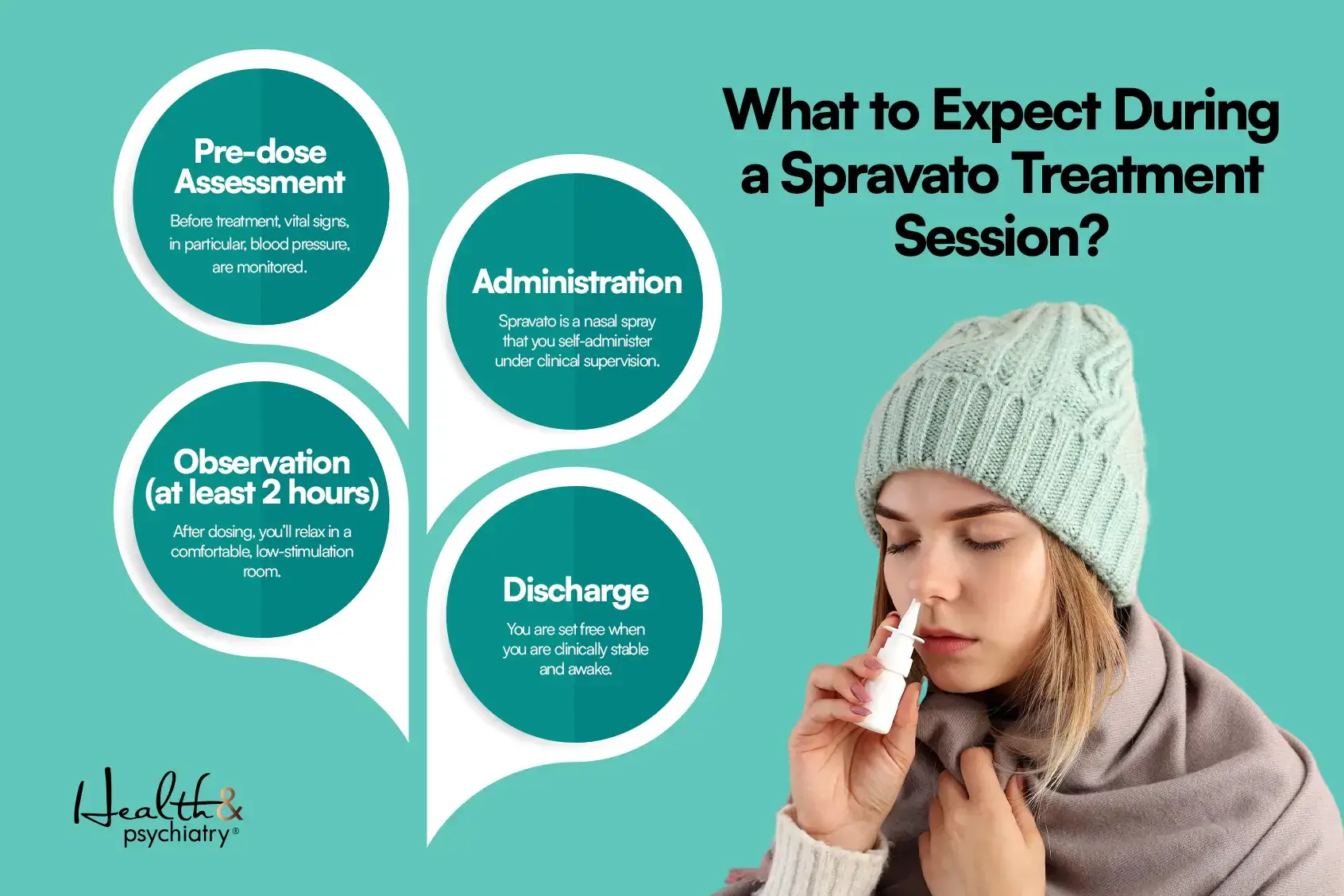
In a normal treatment session, there will be:
→ Pre-dose assessment
Before treatment, vital signs, in particular, blood pressure, are monitored. However, the recent symptoms, medications, and overall stability are also examined by your provider.
→ Administration
Spravato is administered as a nasal spray, administered self-directed, and under clinical supervision. Moreover, employees make sure that the technique and timing between spray machines are correct.
→ Observation (at least 2 hours)
The patients sleep in an observation, comfortable environment following the dosing. Staff of the medical field note dissociation, sedation, blood pressure variations, and nausea.
→ Discharge
You are set free when you are clinically stable and awake. The transportation should be scheduled because driving or working with machinery is not safe till the next day.
How Spravato Side Effects Are Managed and Mitigated?

There are a number of strategies employed by healthcare teams in order to reduce Spravato esketamine side effects:
1. Monitoring blood pressure
Dose taken before and after reading. There can be delays in treatment, modifications in treatment, or medication where necessary.
2. Environmental controls
Sessions are made in low-stimulation rooms. This assists in alleviating anxiety and discomfort with the senses.
3. Symptom management
Anti-nausea or anti-anxiety drugs can be administered where necessary. Moreover, patients are asked to drink and sleep.
4. Gradual dose escalation
The doses are subject to change as time goes by, depending on the response and tolerance. This assists in increasing the comfort and decreasing the intensity of side effects.
Due to the numerous side effects of Spravato, which are rather predictable and short-term, systematic follow-up and supportive care provide a safer and more comfortable treatment process.
Who May Be at Higher Risk for Spravato Side Effects?

Some types of people may be more vulnerable to Spravato esketamine side effects, such as people with:
- Out of control high blood pressure or severe cardiovascular disease.
- Psychotic disorders/mania history.
- Respiratory issues.
- Substance use disorders.
- During pregnancy or breastfeeding (risks are not well-known).
A careful evaluation can assist the providers in customizing treatment and follow-up in response to the risk profiles of individual risks.
Long-Term Safety of Spravato!
Safety data of esketamine on a long-term basis are promising, although in the developing stages. Evidence in the real world, with approximately 1.5 million treatment administrations in more than 58,000 patients, discovered that there were no new major concerns, and the safety profile was similar to clinical trials.
There are also no evident patterns of sustained cognitive deficits, bladder toxicity, or any other chronic side effects of Spravato when used according to the dosage as reported by formal, long-term clinical programs.
Nevertheless, fewer than several years of data imply that continuous observation and a patient-clinician dialogue are valuable aspects of long-term care.
Take the Next Step Toward Relief with Expert Spravato Care!

If you’re exploring Spravato (esketamine) for treatment-resistant depression or severe depressive symptoms, Health & Psychiatry offers compassionate, evidence-based care in a safe and medically supervised environment.
As a trusted mental health and psychiatry provider, Health & Psychiatry delivers REMS-certified Spravato treatment alongside comprehensive psychiatric services to ensure both effectiveness and safety.
Why Choose Health & Psychiatry for Spravato Therapy?
- REMS-certified Spravato administration.
- Board-certified psychiatric providers.
- Careful pre-treatment, initial psychiatric evaluation, screening and monitoring.
- In-clinic observation for blood pressure, sedation, and dissociation.
- Personalized depression treatment plans.
- Ongoing psychiatric follow-up and medication management.
- Support with insurance verification and authorizations.
Trusted Spravato Provider in Florida!
Health & Psychiatry is committed to helping patients who have not found relief with traditional antidepressants. By combining advanced depression treatments like TMS with patient-centered psychiatric care, the clinic supports both short-term symptom relief and long-term mental wellness.
Take the First Step Toward Relief!
If you or a loved one may be a candidate for Spravato therapy:
→ Schedule a consultation with Health & Psychiatry..
→ Get evaluated for Spravato eligibility…
→ Receive expert, supervised depression care!
Your mental health deserves specialized care… and the right support can make all the difference.
FAQs
How long do Spravato side effects last?
Most develop right after dosing and resolve within a few hours, usually by the end of the same day.
Does Spravato cause weight gain?
Weight gain is not commonly reported in clinical trials or safety data.
Does Spravato cause long-term side effects?
Long-term evaluations to date have not identified common persistent adverse effects when Spravato is used correctly, but ongoing data collection continues.
Is Spravato addictive?
While esketamine has abuse potential due to its ketamine relation, the controlled and supervised administration in certified settings minimizes this risk.
Can I drive after Spravato treatment?
No driving or operating heavy machinery should be avoided until the next day due to sedation and perceptual changes.
Who should not take Spravato?
People with uncontrolled hypertension, active psychosis, certain heart or respiratory disorders, or those unable to commit to the required observation protocol should avoid Spravato.