If you’ve ever decided to see a mental health professional, chances are that you have hit the same wall that most people hit: Who am I actually supposed to see?
To start, the medication is prescribed by a psychiatrist. A psychologist administers treatment. A therapist... provides therapy too? Then there are social workers, nurse practitioners, and even pharmacists who participate in care.
This misunderstanding is not insignificant, but stalls treatment. The National Institute of Mental Health suggests that in the U.S., the number of adults under 18 with mental illnesses is almost 59.3 million. The reasons are often barriers to conducting such treatment, such as cost, stigma, and a lack of knowledge on where to begin, because of the types of mental health professionals.
Why Understanding Mental Health Professionals Matters?
Choosing the wrong types of mental health counselors not only postpones the treatment but may result in misdiagnosis, ineffective treatment or even unwarranted expenses. To illustrate, a person with a serious case of depression might require psychiatric medication treatment, and not only talk therapy.
The organizations, such as NAMI and Mental Health America, stress that the correct professional for the correct condition is of high value, particularly in complicated conditions, such as bipolar disorder, PTSD, and substance use disorders.
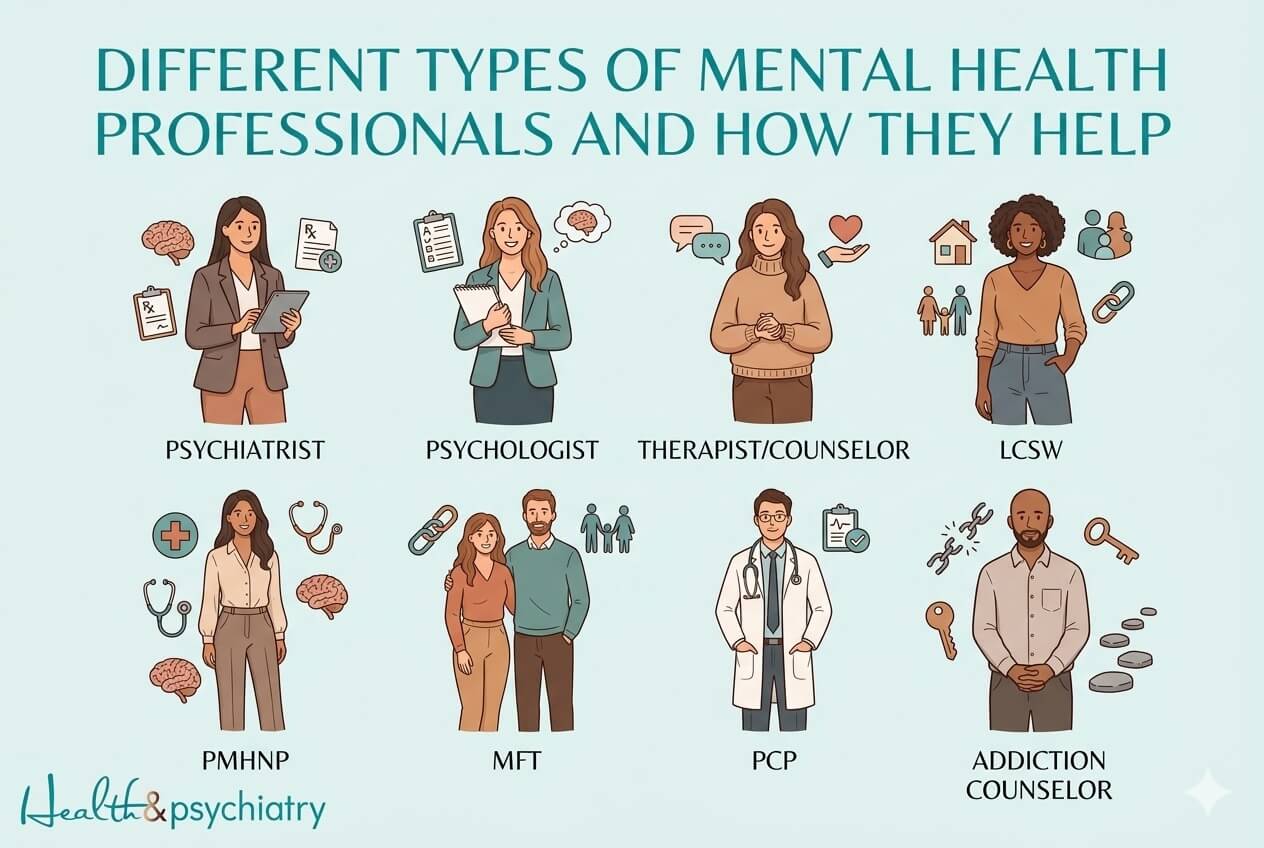
A Quick Difference Between the Types of Mental Health Providers!
|
Professional |
Can Diagnose |
Can Prescribe Medication |
Provides Therapy |
Best For |
|
Psychiatrist |
Yes |
Yes |
Sometimes |
Severe, complex conditions |
|
Psychologist |
Yes |
Rarely |
Yes |
Therapy, assessments |
|
Therapist/Counselor |
Sometimes |
No |
Yes |
Ongoing emotional support |
|
LCSW |
Yes |
No |
Yes |
Therapy + social/environmental issues |
|
PMHNP |
Yes |
Yes |
Yes |
Combined care (meds + therapy) |
|
MFT |
Yes |
No |
Yes |
Relationship/family issues |
|
PCP |
Limited |
Yes |
Limited |
First-line care |
|
Addiction Counselor |
Yes (specialized) |
No |
Yes |
Substance use recovery |
Psychiatrists

Psychiatrists are medical physicians (MDs or DOs), but they deal with mental health.
→ What Psychiatrists Do?
They can diagnose, prescribe, and handle complex psychiatric disorders. The strategy of psychiatrists is frequently biological, psychological & social in nature.
The psych counselors usually deal with situations in which medication is the focus or the symptoms are debilitating, chronic & incurable.
→ What Conditions Do They Treat?
The list of problems that the psychiatrists treat includes schizophrenia, bipolar disorder, major depressive disorder, severe anxiety disorders, and complex traumas.
They are also required in the management of co-occurring disorders such as depression with substance abuse.
Psychologists

Psychologists are physicians who have a doctorate (PhD or PsyD).
→ What Psychologists Do?
They are specialists in the field of psychology testing and assessment, diagnosis, and treatment. They study human behavior and help people manage their emotions and feelings.
The mental health psychologists have been trained properly on evidence-based therapies (including Cognitive Behavior Therapy (CBT), Dialectical Behavior Therapy (DBT) & trauma-focused therapies.
→ What Conditions Do They Treat?
These mental health professionals treat mental, emotional, and behavioral disorders. These include depression, anxiety disorders, OCD, personality disorders, schizophrenia, and PTSD. Psychologists also treat anger issues, phobias, work or relationship problems, etc.
Licensed Therapists and Counselors

There are licensed professional counselors (LPCs), licensed mental health counselors (LMHCs) etc.
→ What Licensed Therapists and Counselors Do?
These professionals are interested in talk therapy, emotional support, and coping abilities. Different types of therapists for mental health are frequently a frontline in access to mental health care due to the nature of their work, which is more accessible and continuous.
→ What Conditions Do They Treat?
The mental health therapists are helpful in stress, anxiety, mild to moderate depression, life transitions and grief, as well as relationship issues. They do not prescribe medication. However, they tend to work with psychiatrists when necessary.
Clinical Social Workers

→ What Clinical Social Workers Do?
The Licensed Clinical Social Workers (LCSWs) integrate therapy with a wider perspective of the social systems, and environment, as well as the community resources. They also tend to assist customers in handling emotional and practical difficulties.
→ What Conditions Do They Treat?
These mental health professionals treat depression, anxiety, and trauma, and social stress factors, including family conflict, chronic disease, and poverty.
Their integrative system is especially helpful to those people who encounter complicated life situations.
Marriage and Family Therapists

→ What Marriage and Family Therapists Do?
Marriage and Family Therapists (MFTs) are experts in the field of relationship dynamics, which are based on the way relationships with others influence mental health. Couples, families, or numerous participants can be involved in therapy.
→ What Conditions Do They Treat?
They deal with marital conflict, parenting issues, communication failures and stress-related to the family. They are also helpful in the treatment of anxiety and depression in case relationship problems are a contributory factor.
Psychiatric Nurse Practitioners

Psychiatric nurse practitioners are medical professionals who are trained to deliver medical care at the advanced practice level.
→ What Psychiatric Nurse Practitioners Do?
Psychiatric Mental Health Nurse Practitioners (PMHNPs) are advanced practice nurses in most states, meaning that they are able to diagnose issues, prescribe medications and offer treatment.
Nurses can also act as the interface between medical and therapeutic treatment, particularly where the services of psychiatrists are inaccessible.
→ What Conditions Do They Treat?
They treat mood disorders, anxiety disorders, ADHD, and other psychiatric disorders that are treated with medication and regular observation.
Addiction Counselors

→ What Addiction Counselors Do?
Addiction counselors are experts in substance use and behavioral addictions and provide systematic assistance, relapse prevention skills and recovery planning.
SAMHSA states that the number of individuals aged 12 and above in the U.S. with a substance use disorder in 2021 is 46 million, which is the reason why special care is urgently required by licensed mental health counselors in Florida.
→ What Conditions Do They Treat?
These mental health counselors treat alcohol use disorder, drug addiction, gambling addiction and other related mental health conditions.
Primary Care Physicians

→ What Primary Care Physicians Do?
Mental health issues are usually attended to by primary care physicians (PCPs). They are able to screen, treat on initial therapeutic levels & prescribe drugs for common ailments.
→ What Conditions Do They Treat?
They generally treat mild to moderate anxiety, depression, and sleeping disorders. Nonetheless, they usually send patients to experts in case of more complicated cases.
Psychiatric Pharmacists

→ What Psychiatric Pharmacists Do?
Psychiatric pharmacists are specialists in the design of medications for mental illnesses. They cooperate with psychiatrists in order to optimize treatment regimens, minimize side effects & promote the use of medications safely.
→ What Conditions Do They Treat?
These pharmacists assist patients who have complicated medication regimens, especially schizophrenia, Bipolar disorder & treatment-resistant depression.
Pastoral Counselors

→ What Pastoral Counselors Do?
Pastoral counselors practice mental health and spiritual or religious counseling. They are also trained in counseling, although they combine faith-based views.
→ What Conditions Do They Treat?
Counselors assist people with grieving, existential issues, some moral dilemmas, and emotional distress on a spiritual level.
How to Choose the Right Mental Health Professional?
The important thing is that when it comes to choosing the right type of mental health practitioner, one should not pay much attention to labels but rather focus on your needs, symptoms, and aims. Here are some pointers to keep in mind.
- In case you believe you require a medication, start with a psychiatrist or PMHNP.
- If you would like emotional therapy, see a psychologist or licensed therapist.
- In case your interest is in relationships, an MFT can be the right choice.
- If it is connected with substance use, consult an addiction counselor.
There is also nothing unusual about having many mental health experts at the same time. For instance, you can see a psychiatrist to prescribe medicine and a therapist to see once a week.
Here’s some advice: Find providers that apply evidence-based practices and are knowledgeable about the treatment of your particular condition.
Find the Best and Most Suitable Mental Health Providers in Florida at Health & Psychiatry!
Searching for the best mental health professionals in Florida to start your wellness retreat?
Health & Psychiatry is a mental health treatment center in Florida that will introduce you to professionals with years of experience in the field of mental health in Florida! Our team makes sure that you are paired with the right provider to get the required medication management, therapy, and specialized treatment.
Get started by making an appointment today! We guide you to a better mental health and a better life!
FAQs
Can psychologists prescribe medication?
No. Usually, psychologists only focus on talk therapy and evaluations rather than medication.
How do you distinguish between a psychiatrist and a psychologist?
A psychiatrist is a medical doctor who prescribes medication, whereas a psychologist is a specialist in therapy and behavioral intervention.
Which mental health professional would I see first?
In the case of mild concerns, a therapist or a primary care doctor is a good place to start. In case of severe symptoms, a psychiatrist should be considered.
What is the best way to select the right mental health provider?
Pay attention to your symptoms, treatment requirements & level of comfort. There is no harm in trying a provider and changing if it does not fit well.