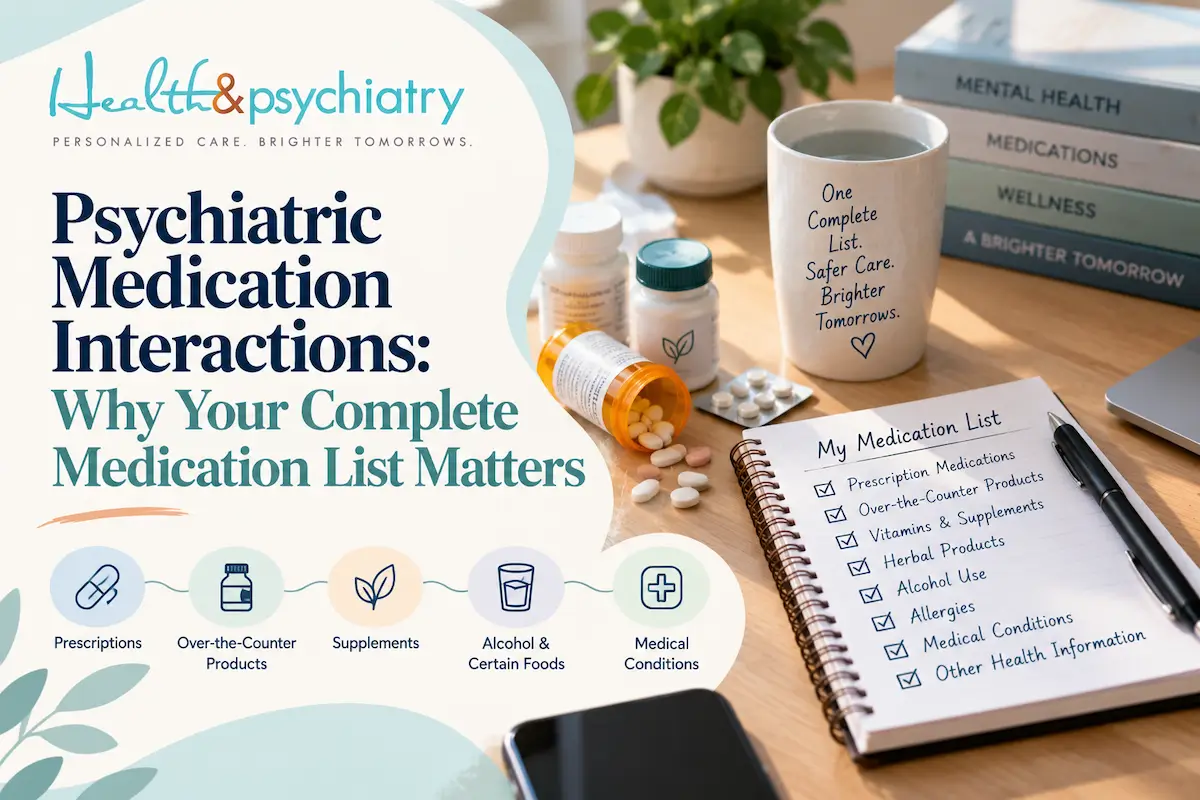
Psychiatric medication interactions can occur when a mental-health medication is affected by another prescription, an over-the-counter product, a supplement, alcohol, certain foods or an existing medical condition. Keeping one accurate medication list helps your psychiatrist and pharmacist identify possible risks, avoid duplicate treatment and make better-informed prescribing decisions.
Key Takeaways
- Your medication list should include more than psychiatric prescriptions.
- Over-the-counter medicines, vitamins, herbal products, alcohol and substances may affect treatment.
- Use one updated list showing the name, dose, schedule and reason for every product.
- Tell each provider about medication changes made by another clinician.
- Do not stop or change a psychiatric medication without professional guidance.
- Seek emergency help for severe or rapidly worsening symptoms.
Why Does Your Psychiatrist Need Your Complete Medication List?
When you meet with a psychiatrist, it may seem sufficient to list only antidepressants, anxiety medications, mood stabilizers or other psychiatric prescriptions. However, a safe review requires a broader picture.
Your clinician may need to know about:
- Prescriptions from every healthcare provider
- Over-the-counter pain and cold medicines
- Sleep aids
- Allergy medicines
- Vitamins and minerals
- Herbal preparations
- Workout or weight-management supplements
- Hormonal medications
- Nicotine products
- Alcohol use
- Cannabis
- Other substances
- Recently stopped medications
- Medication allergies and previous reactions
This information matters because one substance may change how another medicine works. It may increase medication levels, reduce effectiveness or intensify effects such as sedation, dizziness or changes in blood pressure.
The FDA explains that interactions can occur between medications, foods, beverages and health conditions. FDA
You should not be embarrassed about disclosing alcohol, cannabis, non-prescribed substances or supplements. Accurate information supports safer clinical decisions.
What Are Psychiatric Medication Interactions?
A medication interaction occurs when another medicine, substance, food or health condition changes how a medication behaves or affects your body.
Not every interaction produces noticeable symptoms. Not every listed interaction means two medications can never be used together. Some combinations may be avoided, while others may require a dose adjustment, closer monitoring or additional testing.
Only a qualified clinician or pharmacist who understands your complete situation can interpret the significance of a possible interaction.
Common Types of Interactions
| Interaction type | What it means | Information to disclose |
|---|---|---|
| Drug–drug | One medication affects another | All prescriptions and OTC medicines |
| Drug–supplement | A vitamin or herbal product alters treatment | Herbs, vitamins, minerals and powders |
| Drug–alcohol | Alcohol changes medication effects or risks | Amount, frequency and recent changes |
| Drug–food | A food or beverage affects medication | Dietary restrictions and relevant foods |
| Drug–condition | A medical condition changes medication safety | Medical diagnoses, pregnancy and organ problems |
| Therapeutic duplication | Similar products create overlapping effects | Medications from every prescriber |
| Withdrawal-related effect | Sudden reduction or discontinuation causes symptoms | Recently stopped or missed medications |
MedlinePlus notes that even commonly used medicines may interact with food, alcohol or other medicines. MedlinePlus
What Is Medication Reconciliation?
Medication reconciliation is the process of building and reviewing a complete, accurate medication list.
The clinician compares what you are actually taking with:
- The medications shown in your chart
- Recent prescriptions
- Recommendations from other providers
- Your pharmacy information
- Medications you recently stopped
- The proposed treatment plan
The Agency for Healthcare Research and Quality describes medication reconciliation as a process used to identify discrepancies and help prevent medication errors or adverse drug events. PSNet
Medication reconciliation may identify:
- A medication missing from the medical record
- An incorrect dose
- A medication you no longer take
- Duplicate prescriptions
- Conflicting instructions
- More than one provider prescribing a similar product
- A supplement that could affect treatment
- A recently discontinued medicine still listed as active
- A pharmacy record that does not reflect how you take the medication
Medication reconciliation is not about blaming the patient or another clinician. Medical records, pharmacy histories and patient routines can change at different times. The goal is to create one reliable version of the current regimen.
What Should Be Included in a Complete Medication List?
For every medication or product, record:
- Brand name, if known
- Generic name, if known
- Strength or dose
- How much you take
- How often you take it
- What time you take it
- Why you take it
- Who prescribed or recommended it
- When you started it
- Whether you take it regularly or only as needed
Include all of these categories
Prescription medications
List prescriptions from:
- Psychiatrists
- Primary-care clinicians
- Urgent-care centers
- Emergency departments
- Neurologists
- Pain specialists
- Cardiologists
- Sleep specialists
- Dermatologists
- Other healthcare providers
Over-the-counter products
Patients sometimes forget to report:
- Pain relievers
- Cold and cough products
- Allergy medicines
- Motion-sickness products
- Sleep aids
- Heartburn treatments
- Laxatives
- Decongestants
“Over the counter” does not mean “unable to interact.”
Vitamins and supplements
Include:
- Multivitamins
- Herbal products
- Minerals
- Melatonin
- Energy supplements
- Pre-workout products
- Weight-management supplements
- Products marketed for mood, sleep or concentration
Dietary supplements may interact with prescription medications, alter their effects or increase certain risks. MedlinePlus
Alcohol, nicotine, cannabis and other substances
Tell your clinician what you use, how frequently and whether your use has recently changed.
Alcohol can interact with many medications and may contribute to sedation, impaired coordination, falls, accidents or other adverse effects. The specific risk depends on the medication, dose, alcohol use and individual medical circumstances. niaaa.nih.gov
Recently stopped medications
A recently discontinued medication may still matter because:
- Effects may continue after the last dose.
- Withdrawal or discontinuation symptoms may occur.
- A new medication may overlap temporarily.
- The treatment change may explain new symptoms.
- Your pharmacy record may still show it as active.
Record the approximate date and reason the medication was stopped. State whether you stopped it independently or under professional guidance.
Copyable Medication-List Template
| Product | Dose | Schedule | Reason | Prescriber | Started/stopped | Notes |
| Medication or supplement name | Strength and quantity | Morning, evening or as needed | Condition or symptom | Provider name | Approximate date | Benefits, side effects or missed doses |
Keep this list:
- On your phone
- In your patient portal
- In your wallet
- With a trusted caregiver, when appropriate
- Available during every medical appointment
Update it whenever something starts, stops or changes.
AHRQ recommends maintaining one dependable medication list that can serve as a shared source of truth across the patient’s healthcare team. ahrq.gov
Why Pharmacy Records May Not Be Enough
Pharmacy records can be useful, but they may not show the complete picture.
A record may not reveal:
- Whether you actually started the medicine
- Whether you stopped taking it
- The dose you currently use
- Samples received from a clinic
- Products purchased from another pharmacy
- Over-the-counter medicines
- Supplements
- Alcohol or cannabis use
- Medications obtained during travel
- Medication borrowed from another person
- How frequently you use an “as needed” prescription
Bring pharmacy records when available, but also explain what you are actually taking.
What Can Increase the Risk of Medication Interactions?
Possible risk factors include:
- Taking several medications
- Seeing multiple healthcare providers
- Using more than one pharmacy
- Recent hospitalization
- Frequent medication changes
- Forgetting medication names or doses
- Taking medications differently from the label
- Kidney or liver conditions
- Pregnancy or pregnancy planning
- Older age
- Alcohol or substance use
- Starting supplements without discussing them
- Sharing medication
- Using leftover prescriptions
- Restarting an old medication independently
Having a risk factor does not mean that an interaction will occur. It means that careful review may be particularly important.
Side Effect or Medication Interaction: What Is the Difference?
| Question | Side effect | Medication interaction |
|---|---|---|
| Basic meaning | An unwanted effect that may occur with one medicine | A change caused by another medication, substance, food or condition |
| Can it happen after one medicine? | Yes | An interaction requires another contributing factor |
| Timing | May begin after starting or changing a medication | May begin after adding, stopping or changing another product |
| Does timing prove the cause? | No | No |
| What should you do? | Report concerning symptoms to the prescriber | Report symptoms and disclose every product being used |
| Should you stop treatment yourself? | Generally no | Generally no |
A new symptom cannot reliably be identified as a side effect, interaction, illness or withdrawal based only on an online description. A clinician may need to review timing, doses, medical history and other factors.
Symptoms That Should Be Reported Promptly
Contact your prescribing clinician promptly for new, persistent or worsening symptoms after a medication or substance change, such as:
- Marked dizziness
- Excessive sleepiness
- Unusual restlessness or agitation
- Confusion
- Significant tremor
- Vomiting or diarrhea that continues
- New heart-racing sensations
- Major blood-pressure changes
- Unusual bruising or bleeding
- New rash
- Severe insomnia
- Significant mood elevation
- Worsening depression
- Suicidal thoughts
- Unexpected changes in coordination
This list is not exhaustive and does not establish that an interaction has occurred.
Seek emergency help for severe symptoms
Call 911 or go to the nearest emergency room for symptoms such as:
- Difficulty breathing
- Loss of consciousness
- Seizure
- Severe confusion
- Chest pain
- Sudden weakness or difficulty speaking
- Severe allergic swelling
- Very high fever with marked rigidity or agitation
- Immediate risk of self-harm or harm to another person
If you have suicidal thoughts or cannot remain safe, call or text 988 in the United States.
Do not drive yourself if you are severely sedated, confused, faint or otherwise impaired.
Why You Should Not Stop Psychiatric Medication Suddenly
Discovering a possible interaction online can feel alarming. However, independently stopping a psychiatric medication may cause:
- Discontinuation symptoms
- Return of the treated condition
- Sleep disruption
- Anxiety or agitation
- Mood instability
- Physical symptoms
- Confusion about which medication caused the problem
The appropriate response depends on:
- The medicines involved
- Their doses
- How long you have taken them
- The suspected interaction
- Your symptoms
- Your medical history
- Whether the situation is urgent
Contact the prescriber or pharmacist for individualized guidance unless emergency symptoms require immediate care.
Questions to Ask During Medication Management
Bring these questions to your next appointment:
- Could any of my current medications affect each other?
- Do my supplements belong on the medication list?
- Are there foods or beverages I should discuss?
- What should I know about alcohol while taking this medication?
- Which side effects require an urgent call?
- What monitoring or laboratory tests may be needed?
- Should the medicine be taken with food?
- What should I do if I miss a dose?
- Which provider should manage refills?
- How should I communicate a medication change made elsewhere?
- Should I use one pharmacy for all prescriptions?
- When should we review the list again?
Avoid using a generic online interaction checker as the final decision-maker. A checker may flag a theoretical interaction without knowing your diagnosis, dose, treatment history or monitoring plan.
Multiple Prescribers and Pharmacies: How to Reduce Confusion
Tell every prescriber about every medication
A medication prescribed for pain, infection, allergies, sleep, blood pressure or another condition may still be relevant to psychiatric treatment.
Designate a primary medication list
Keep one list rather than separate psychiatric and medical lists. Update the same document after every change.
Use one pharmacy when practical
Using one pharmacy may help the pharmacist identify potential overlap. However, it does not replace disclosing over-the-counter medicines, supplements and substances.
Ask who is responsible for each medication
When care involves several clinicians, confirm:
- Who prescribes each medication
- Who monitors it
- Who orders laboratory work
- Who should be contacted about side effects
- Who approves dose changes
- How the providers will coordinate
Bring discharge paperwork
After emergency treatment or hospitalization, bring the discharge medication list to your psychiatric follow-up. Clearly mark what was started, stopped or changed.
How Medication Review Works at a Psychiatric Appointment
A medication-management appointment may include:
1. Medication reconciliation
The provider compares your current list with the chart, recent prescriptions and information from other clinicians.
2. Symptom review
You may discuss changes in:
- Mood
- Anxiety
- Sleep
- Energy
- Concentration
- Appetite
- Daily functioning
- Safety
3. Benefit and side-effect review
The provider considers what has improved, what has not changed and what new problems have developed.
4. Interaction assessment
The clinician reviews other prescriptions, OTC products, supplements, alcohol, substances and medical conditions.
5. Monitoring plan
Depending on the treatment, the provider may discuss vital signs, laboratory testing, follow-up timing or coordination with another clinician.
6. Shared treatment decision
Possible next steps may include continuing treatment, additional monitoring, adjusting a dose, changing medication or considering another option.
No single decision is appropriate for every patient.
Psychiatric Medication Management in Tampa Bay and Florida
Health & Psychiatry provides psychiatric medication-management services from its Oldsmar clinic, serving adults across Tampa Bay communities such as Clearwater, Palm Harbor, Safety Harbor, Westchase and nearby areas.
Eligible Florida patients may also be able to attend appropriate follow-up appointments through telepsychiatry. Availability depends on clinical circumstances, provider authorization and the type of monitoring required.
The clinic is located at:
3919 Tampa Road, First Floor
Oldsmar, FL 34677
Whether you attend in person or virtually, prepare the same complete medication list. Include products prescribed by every clinician, OTC medicines, supplements and recent changes.
Frequently Asked Questions
Psychiatric medication interactions occur when another medicine, substance, food, supplement or medical condition changes how a mental-health medication works or affects the body.
Include every prescription, OTC medicine, vitamin, herbal product, supplement and recently stopped medication. Also discuss alcohol, cannabis, nicotine and other substances.
Yes. Vitamins, minerals and herbal products can be relevant to treatment and may affect medications or monitoring recommendations.
Alcohol may change medication effects and can increase risks such as sedation, impaired coordination or other adverse reactions. Ask your prescriber about your specific medication and circumstances.
Do not independently stop or change psychiatric medication based only on an online checker. Contact your prescriber or pharmacist for individualized guidance. Seek emergency care for severe symptoms.
Nonpsychiatric prescriptions can affect psychiatric medications, symptoms and treatment decisions. A complete list also helps identify duplication and conflicting instructions.
Not always. It may omit OTC products, supplements, medicines from another pharmacy and medications that you stopped or take differently than prescribed.
Update it whenever a medicine, dose, schedule, supplement or substance use pattern changes. Review it before every healthcare appointment.
Many medication reviews may be completed virtually when clinically appropriate. Some circumstances may require vital signs, laboratory testing, medical coordination or an in-person examination.
Schedule a Medication Review
A complete medication list helps your psychiatric provider understand the full treatment picture. Include prescriptions, OTC products, supplements, alcohol or substance use and recently discontinued medications—even when they do not seem related to mental health.
If you have questions about possible psychiatric medication interactions, do not rely on guesswork or independently change treatment.
Request a medication-management appointment with Health & Psychiatry to discuss your medication list, symptoms and treatment goals.
Medical Disclaimer
This article is for general educational purposes. It does not identify a medication interaction, recommend starting or stopping medication or replace guidance from a qualified prescriber or pharmacist. Individual risks and treatment decisions vary.