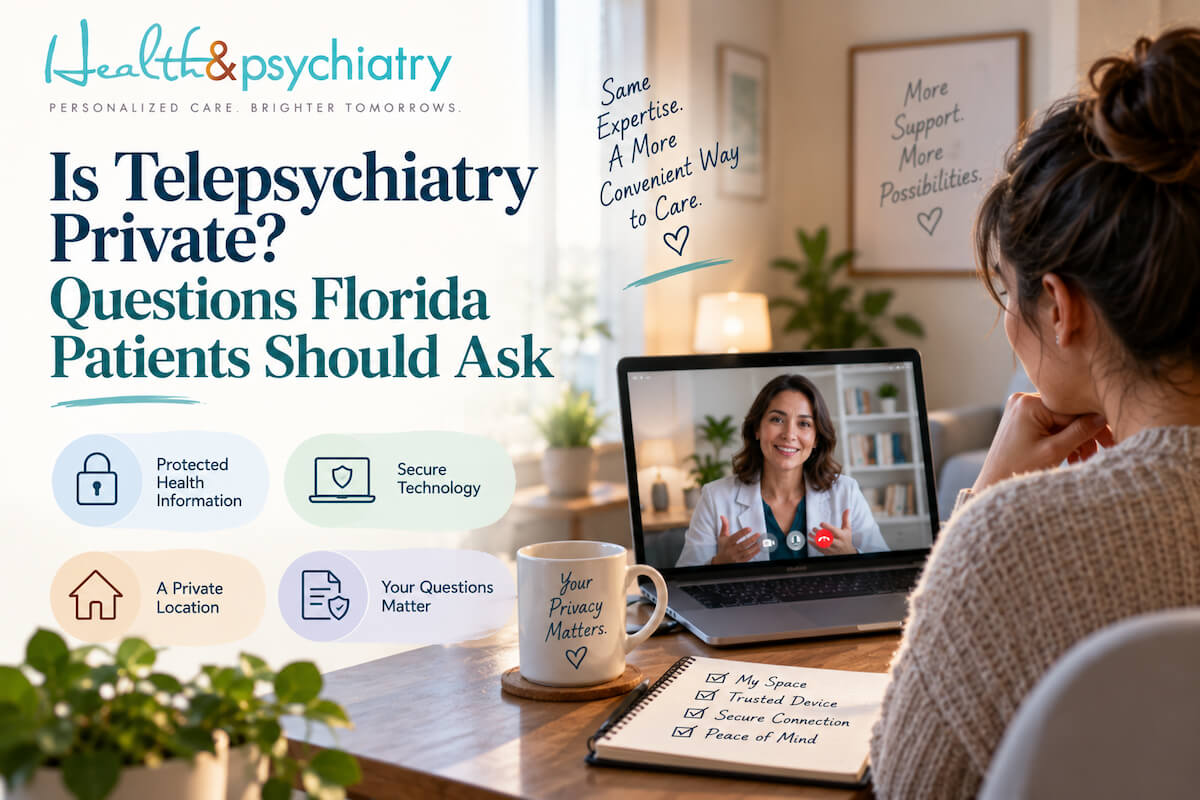
Telepsychiatry can provide private psychiatric care when the practice uses appropriate technology, protects health information and follows applicable privacy requirements. However, telepsychiatry privacy also depends on where you attend, which device and network you use, whether anyone can overhear you and how the service handles recordings, messages and patient data.
Key Takeaways
- Covered healthcare providers must protect telehealth information under applicable HIPAA requirements.
- A “HIPAA-compliant” label does not eliminate every privacy risk.
- Ask whether the video session is recorded and how messages are stored.
- Attend from a private location using a trusted device and secure network.
- Avoid employer-owned devices if workplace monitoring could affect confidentiality.
- Confirm whether the service is a healthcare practice or a consumer wellness application.
- Your provider may ask for your physical location for licensing and emergency planning.
- Read the practice’s Notice of Privacy Practices before your appointment.
Is Telepsychiatry Private?
In many cases, yes. Telepsychiatry can allow you to discuss personal mental-health concerns privately with a qualified provider through secure telecommunications technology.
A responsible telepsychiatry practice should use appropriate administrative, technical and physical safeguards to protect patient information. These safeguards may address:
- Video and audio transmission
- Patient identity verification
- Electronic health records
- Appointment messages
- Staff access to patient information
- Device security
- Patient consent
- Emergency procedures
- Record retention and disclosure
The American Psychiatric Association recommends secure, trusted videoconferencing platforms and appropriate safeguards such as encryption and device-security controls. Psychiatry.org
However, no online service can promise zero risk. Privacy depends on both the practice’s systems and your appointment environment.
If confidentiality concerns have prevented you from seeking care, you can review Health & Psychiatry’s online psychiatric care in Florida and ask the scheduling team how virtual appointments and patient information are handled.
What Does HIPAA Mean for Telepsychiatry Privacy?
HIPAA is a federal law that establishes requirements for covered healthcare providers, health plans and their business associates when they use or disclose protected health information.
For telepsychiatry, protected information may include:
- Your identity
- Appointment history
- Symptoms discussed during the session
- Diagnoses
- Medications
- Treatment plans
- Billing information
- Messages sent through a patient portal
- Clinical notes
- Laboratory or medical records
HHS states that telehealth services delivered by covered providers and health plans must comply with the HIPAA Rules. Technology vendors working with covered organizations may also need appropriate business-associate arrangements. HHS.gov
HIPAA does not mean that:
- Every health or wellness application is covered.
- No data breach could ever occur.
- Every consumer video application is appropriate for psychiatric care.
- Your home, office or vehicle is automatically private.
- Your employer cannot monitor an employer-owned device.
- A family member cannot overhear a session.
- Every communication method has the same protections.
Therefore, asking how a practice protects information remains reasonable even when it describes its services as HIPAA compliant.
Telepsychiatry Privacy: Provider and Patient Responsibilities
| Privacy area | Provider’s responsibility | Patient’s responsibility |
|---|---|---|
| Video technology | Select and configure appropriate systems | Use the approved appointment link |
| Clinical records | Restrict and monitor access | Protect portal passwords |
| Appointment location | Use an appropriate professional setting | Find a private place to speak |
| Internet security | Protect practice networks and systems | Avoid unsecured public Wi-Fi |
| Device security | Secure practice-owned devices | Update and lock personal devices |
| Identity verification | Confirm the patient’s identity | Provide accurate identifying information |
| Consent | Explain telehealth processes and limitations | Read forms and ask questions |
| Recording | Explain whether recording occurs | Do not record without authorization |
| Emergencies | Maintain an appropriate response plan | Provide an accurate current location |
| Messages | Provide approved communication channels | Avoid sending health details through unapproved channels |
Privacy works best when the practice and patient both understand their roles.
10 Privacy Questions to Ask Before a Telepsychiatry Appointment
1. What video platform will we use?
Ask the practice for the platform name and whether you must install an application.
You can also ask:
- Will I receive a private appointment link?
- Does the link expire?
- Is a password or waiting room used?
- Can someone enter the appointment without permission?
- Who provides technical support?
You do not need to understand every technical detail. The practice should still be able to explain its privacy process clearly.
2. Is the video and audio encrypted?
Encryption helps make information unreadable to unauthorized parties while it is transmitted or stored.
The American Psychiatric Association identifies encrypted audio and video transmission as an important telepsychiatry security consideration. Psychiatry.org
Encryption is only one safeguard. Account access, staff permissions, record handling and patient behavior also affect privacy.
3. Will my appointment be recorded?
Do not assume that a virtual visit is or is not recorded.
Ask:
- Are video or audio sessions recorded?
- If so, why?
- Will I be asked for consent?
- Where would a recording be stored?
- Who could access it?
- How long would it be retained?
- Can I decline recording?
The practice should explain any recording policy before the session. Patients should also avoid recording appointments without discussing it with the provider and considering applicable consent requirements.
4. How will my medical information be stored?
The video call is only one part of telepsychiatry. Clinical information may also pass through:
- Electronic health records
- Patient portals
- Text messages
- Online intake forms
- Billing systems
- Electronic prescribing systems
- Laboratory portals
Ask which communication methods the practice authorizes for medical information. Do not send sensitive details through ordinary email, social-media messaging or text unless the practice specifically instructs you to use that method.
5. Who can access my information?
Access should be limited to people who need the information for treatment, healthcare operations, billing or another authorized purpose.
Depending on your care, appropriate access might involve:
- Your psychiatric provider
- Authorized clinical staff
- Scheduling personnel
- Billing staff
- A pharmacy
- A laboratory
- Another treating clinician
- An approved technology vendor
Ask how the practice manages staff access and whether your information may be shared with other providers involved in your care.
6. What happens if another person is in the room?
Both you and the provider should have an environment that supports confidential communication.
At the start of the visit, tell your provider if another person is present. If you want a partner, caregiver or family member to participate, the provider may confirm that you consent to that person’s presence.
You can also ask the provider to confirm whether anyone else is in their location.
7. How does the practice handle emergencies?
Your provider may ask for:
- Your physical location
- Your current address
- A callback number
- An emergency contact
- Local emergency-service information
These questions may feel personal, but they support safety planning when the provider is not physically in the same room.
Providing your location does not eliminate confidentiality. It helps the clinician understand where you are receiving care and how to respond if an urgent safety concern develops.
8. How will prescriptions and pharmacy information be handled?
If medication is discussed, ask how the practice:
- Confirms your pharmacy
- Sends prescriptions
- Reviews your medication history
- Receives refill requests
- Communicates about side effects
- Coordinates required monitoring
Do not post medication questions in public comments or social-media messages. Use the practice’s approved communication method.
A virtual appointment does not guarantee a prescription, refill or particular medication. The provider must determine what is clinically appropriate and permitted.
9. Can I receive a copy of the privacy policy?
Covered providers generally give patients a Notice of Privacy Practices explaining how protected information may be used and disclosed.
Review:
- Permitted uses of information
- Your privacy rights
- How to request records
- How to request corrections
- How to raise a privacy concern
- Whom to contact with questions
A privacy policy should be understandable and accessible. Ask for clarification when a section is unclear.
10. Does the service use tracking, analytics or third-party tools?
This question is especially important when comparing a medical practice with a consumer wellness platform.
Ask whether the website, application or intake process uses:
- Advertising pixels
- Analytics software
- Third-party forms
- Artificial-intelligence tools
- Automated transcription
- Session-recording software
- External messaging platforms
You can also ask whether any AI-assisted documentation tool is used during visits and, if so, how patient information is handled.
Is Every Mental-Health Application Protected by HIPAA?
No. HIPAA applies to specific covered entities and business associates. A consumer wellness application, self-help platform or symptom-tracking tool may collect health-related information without operating as a HIPAA-covered healthcare provider.
Before entering sensitive information, determine whether the service is:
- A licensed healthcare practice
- A patient portal belonging to your provider
- A clinical telehealth vendor
- A general wellness application
- A social platform
- A marketing questionnaire
- An online prescription marketplace
Look for:
- The provider’s identity and credentials
- A Notice of Privacy Practices
- Clear contact information
- Terms describing data use
- Information about third-party sharing
- A process for privacy questions
- An explanation of whether data is sold or used for advertising
HHS specifically advises patients that telehealth websites, applications and portals can create privacy risks and recommends taking steps to protect health information. HHS.gov
How to Create a Private Telepsychiatry Environment
Even a secure platform cannot prevent someone nearby from overhearing you.
Before the appointment
- Choose a room with a closable door.
- Tell household members that you need uninterrupted private time.
- Test your camera, microphone and internet connection.
- Update your device and browser.
- Use a strong password or biometric lock.
- Turn off smart speakers and voice assistants.
- Close work email and unrelated browser tabs.
- Disable on-screen message previews.
- Position the screen away from windows and doors.
- Keep written records out of camera view.
During the appointment
- Use headphones when other people are nearby.
- Confirm who is present on both sides.
- Avoid discussing sensitive matters before the secure session begins.
- Tell your provider if privacy changes during the visit.
- Do not allow another person to join without discussing it.
- Avoid taking screenshots or recordings.
- Keep the device stationary and charged.
After the appointment
- Log out of the portal.
- Close the application or browser.
- Store written instructions securely.
- Delete downloaded files from shared devices.
- Do not leave prescription or appointment information open.
- Contact the practice through its approved channel if you have questions.
Is It Safe to Attend Telepsychiatry From Work?
It may be possible, but privacy should be evaluated carefully.
Potential concerns include:
- Coworkers overhearing the session
- Glass walls or shared offices
- Employer monitoring software
- Employer-controlled internet networks
- Calendar notifications visible to others
- Shared computers
- Workplace security cameras
- Unexpected interruptions
An employer-owned laptop or phone may have monitoring, logging or device-management software. An incognito browser window does not disable employer monitoring.
When possible, use:
- Your personal device
- A personal internet connection
- A private room
- Neutral calendar wording
- Headphones
- A scheduled block with enough time before and after the session
Do not attend while driving, even if you intend to use audio only. Park in a safe, private location before connecting.
Considering virtual psychiatric care in Florida?
Learn what to expect from Health & Psychiatry’s Florida telepsychiatry services and ask the team about privacy, eligibility and appointment options.
Is Public Wi-Fi Appropriate for a Psychiatry Appointment?
A trusted private connection is preferable.
Public Wi-Fi in airports, hotels, cafés or shared workspaces may create additional security and privacy concerns. Even if the appointment platform uses encryption, people nearby may see your screen or hear the conversation.
If you cannot access a private network:
- Consider using a personal cellular connection.
- Avoid networks that do not require authentication.
- Do not access the appointment from a public computer.
- Sit where other people cannot view your screen.
- Use headphones.
- Confirm that your device’s firewall and updates are current.
- Ask the practice whether rescheduling is safer.
Convenience should not outweigh your ability to communicate privately and safely.
Can Family Members Participate in a Virtual Appointment?
A family member, partner or caregiver may participate when appropriate and when you consent.
Before including someone, consider:
- Do you want them present for the entire appointment?
- Would you speak as openly with them in the room?
- Should they join only for a specific section?
- Do they understand that your information is private?
- Does the provider need formal permission to discuss your care with them later?
You may ask to speak with your provider alone, even when another person helped arrange the appointment.
Are Telepsychiatry Sessions Confidential in Every Situation?
Psychiatric information receives important privacy protections, but confidentiality is not absolute.
A clinician may be required or permitted to disclose limited information in circumstances involving:
- Immediate risk of serious harm
- Suspected abuse or neglect
- Certain court or legal requirements
- Healthcare operations permitted by law
- Insurance billing
- Coordination with authorized treating providers
- Other legally recognized exceptions
Ask the provider to explain confidentiality and its limits during informed consent. The same general legal and ethical responsibilities that apply to office-based care continue to matter during virtual care.
Telepsychiatry Privacy Red Flags
Pause and ask questions if a service:
- Cannot identify the treating provider.
- Does not provide a privacy notice.
- Pressures you to submit sensitive information through social media.
- Uses vague language about selling or sharing health data.
- Promises a prescription before an appropriate evaluation.
- Requests unnecessary information without explaining why.
- Cannot explain whether sessions are recorded.
- Encourages appointments from unsafe or public locations.
- Does not verify your identity or physical location.
- Does not explain what to do during an emergency.
- Uses public testimonials that appear to reveal treatment details.
- Makes absolute claims that a platform is “100% secure.”
One unclear answer does not automatically mean a service is unsafe. However, responsible practices should take privacy questions seriously.
Telepsychiatry Privacy for Florida Patients
For Florida patients, privacy is one part of choosing appropriate online psychiatric care. You should also confirm:
- The provider is authorized to treat patients in Florida.
- You can be physically located in Florida during the appointment.
- The requested service is suitable for telepsychiatry.
- Your insurance benefits have been reviewed.
- The practice has a plan if in-person care becomes necessary.
- You know how to reach the practice between appointments.
- You understand what to do during an emergency.
Health & Psychiatry provides telepsychiatry for eligible Florida patients and maintains an in-person clinic at:
3919 Tampa Road, First Floor
Oldsmar, FL 34677
Patients throughout Florida may request virtual appointments when clinically appropriate. Some examinations, procedures, emergencies and monitoring requirements still require in-person care.
Frequently Asked Questions
Telepsychiatry can be private when the practice uses appropriate systems and safeguards and the patient attends from a confidential location. Privacy also depends on the device, network, surroundings and communication methods used.
Telepsychiatry provided by a HIPAA-covered healthcare provider must follow applicable HIPAA requirements. Not every wellness application or online platform is necessarily a covered healthcare provider.
Recording policies vary. Ask whether video or audio is recorded, why recording would occur, how consent is obtained, where it is stored and who could access it. Do not assume that sessions are recorded.
A personal device is generally preferable because employer-owned devices may contain monitoring or device-management software. If you must use a work device, review employer policies and discuss privacy concerns with the practice.
Another person may participate when appropriate and with your consent. Tell your provider who is present. You can request to speak with the provider privately.
The provider may confirm your location for licensing, identity verification and emergency planning. Your location helps the practice identify appropriate emergency resources if a serious safety concern arises.
A trusted private network is safer. Public networks and shared spaces may increase the risk that someone can view your screen, overhear the appointment or access information on an unsecured device.
Ask the practice about its video platform, encryption, recordings, messaging, patient portal, privacy notice, third-party vendors and emergency procedures before sharing sensitive information.
Request a Private Telepsychiatry Appointment in Florida
You should not have to choose between convenient care and informed privacy decisions.
Before scheduling, ask how the practice protects video appointments, records, messages and patient information. Then prepare a confidential space where you can speak openly without interruption.
Eligible patients can explore online psychiatric care in Florida or request an appointment with Health & Psychiatry to discuss virtual-care options.
Crisis Support
Telepsychiatry is not a replacement for emergency care. If you or someone else may be in immediate danger, call 911 or go to the nearest emergency room. In the United States, call or text 988 for crisis support.
Medical Disclaimer
This article provides general educational information and is not medical or legal advice. It does not establish a provider-patient relationship, determine telepsychiatry eligibility or replace individualized guidance from a qualified healthcare professional.