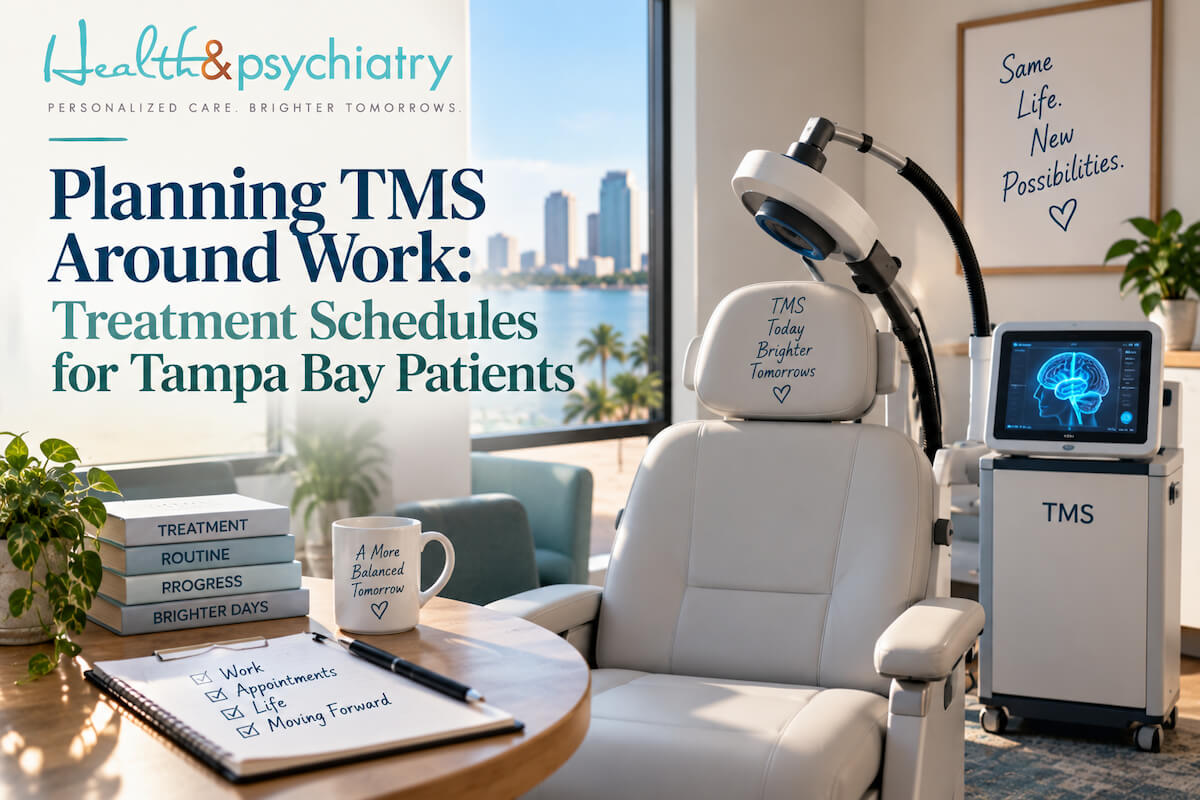
A traditional TMS treatment schedule often involves in-person treatment five days per week for approximately four to six weeks. The first visit may take longer because it can include mapping and motor-threshold measurements. Later sessions may be much shorter, depending on the device and prescribed protocol. Most patients remain awake and can usually resume ordinary activities afterward, but individual experiences vary.
Tampa Bay adults can review TMS therapy at Health & Psychiatry and ask the clinic for a personalized time estimate before making work arrangements.
Key Takeaways
✅ Traditional TMS frequently involves weekday appointments over several weeks.
✅ The exact number and length of sessions depend on the diagnosis, device, protocol, response, and prescriber.
✅ The first mapping appointment may require more time than later treatment sessions.
✅ TMS usually does not require anesthesia, and most patients can return to ordinary activities afterward.
✅ Commute, check-in, parking, clinical reviews, and possible side effects should be included in your schedule.
✅ Discuss work travel, holidays, and expected absences with the clinic before treatment starts.
What Is a Typical TMS Treatment Schedule?
TMS is an outpatient treatment that uses magnetic pulses to stimulate specific areas of the brain. Because its effects develop across repeated treatments, it is generally provided as a series rather than as a single appointment.
A common schedule for depression involves:
- Treatment five days per week
- Weekday appointments
- Approximately four to six weeks of acute treatment
- A longer initial appointment for mapping
- Shorter recurring treatment visits
- Periodic symptom and progress reviews
- Possible schedule adjustments based on response and tolerability
However, there is no universal schedule that applies to every patient.
The prescribed course can depend on:
- The condition being treated
- The TMS device
- The stimulation protocol
- Session duration
- Previous treatment
- Clinical response
- Side effects
- Insurance authorization
- Missed appointments
- The treating psychiatrist’s recommendations
Your actual schedule should come from the treating clinic—not from a general online timeline.
How Long Does Each TMS Appointment Take?
Treatment time and total appointment time are not always the same.
A clinic may ask you to allow time for:
- Arrival and check-in
- Any symptom or safety updates
- Equipment setup and positioning
- The prescribed stimulation
- Brief post-treatment questions
- Progress assessments on selected days
- Scheduling or insurance discussions when needed
The First Appointment
The initial treatment appointment may take approximately an hour because the clinician must identify the treatment position and determine an appropriate stimulation level. This process is often called mapping and motor-threshold determination.
The first visit can include:
- Review of safety information
- Confirmation of medication or health changes
- Positioning the treatment coil
- Determining the motor threshold
- Identifying the treatment location
- Explaining what the patient will feel and hear
- Delivering the initial treatment when appropriate
Mayo Clinic notes that the first appointment commonly lasts about an hour because it includes this setup and mapping process.
Do not schedule an important meeting immediately after the initial visit until the clinic confirms how much time you should allow.
Recurring Treatment Sessions
Later sessions are generally more predictable because the treatment location and settings were established during mapping.
The stimulation itself might last only a few minutes under some protocols or approximately 20 minutes under others. Different devices and protocols can take longer. Your total visit will also include arrival, positioning, setup, and departure time.
Health & Psychiatry’s existing educational material describes sessions as varying by protocol rather than having one fixed duration. healthandpsychiatry.com
Ask the clinic these two separate questions:
- How long will the stimulation last?
- How much total time should I reserve from arrival to departure?
Example TMS Schedule for a Working Adult
The following is a planning example—not an individual treatment prescription.
| Time | Possible activity |
|---|---|
| 7:40 a.m. | Arrive and check in |
| 7:45 a.m. | Brief clinical update and preparation |
| 7:50 a.m. | Treatment begins |
| 8:10 a.m. | Treatment or appointment concludes |
| 8:15 a.m. | Leave the clinic |
| 8:45 a.m. | Arrive at work, depending on traffic |
Another person may use a late-afternoon appointment:
| Time | Possible activity |
|---|---|
| 4:30 p.m. | Finish or pause work |
| 5:00 p.m. | Arrive at the clinic |
| 5:10 p.m. | Treatment begins |
| 5:30 p.m. | Appointment concludes |
| 6:00 p.m. | Return home, depending on traffic |
These examples should not be interpreted as available Health & Psychiatry appointment times. Confirm current scheduling options directly with the clinic.
Can You Work Before or After TMS?
Many patients can work before or after a TMS appointment.
TMS generally:
- Does not require general anesthesia
- Does not routinely require sedation
- Allows the patient to remain awake
- Does not usually involve a post-procedure recovery period
- Allows many patients to drive and resume ordinary activities
Mayo Clinic says patients can generally return to normal activities after treatment and can usually work and drive between appointments. Health & Psychiatry similarly states on its service page that patients can generally drive and resume normal activities after a session. Book an Appointment
However, “no routine downtime” does not mean that every patient will feel exactly the same.
Possible short-term effects include:
- Scalp discomfort
- Headache
- Tingling
- Facial-muscle twitching during stimulation
- Temporary lightheadedness
- Fatigue or mental strain related to the underlying condition
These effects are often mild, but experiences vary. Mayo Clinic lists headache, scalp discomfort, lightheadedness, and temporary facial sensations among possible side effects.
For your first few appointments, consider leaving a small buffer before driving a long distance, attending an important meeting, or performing safety-sensitive work.
How Much Time Should You Block on Your Calendar?
Use the following formula:
Total time away = travel + parking + check-in + treatment + checkout + return travel + personal buffer
For example:
| Schedule component | Estimated planning block |
|---|---|
| Travel to the clinic | 20–40 minutes |
| Parking and check-in | 10–15 minutes |
| Treatment visit | Confirm with clinic |
| Personal buffer | 10–15 minutes |
| Travel to work or home | 20–40 minutes |
Tampa Bay traffic can change significantly based on the time of day, construction, weather, and route. Patients traveling to Oldsmar from Tampa, Westchase, Clearwater, Palm Harbor, Safety Harbor, or another nearby community should calculate the entire door-to-door commitment.
Test the route during the same time window as the proposed appointment before finalizing your work arrangement.
Questions to Ask Before Choosing an Appointment Time
Bring these questions to the scheduling team:
- How long is my first mapping appointment?
- How long should I reserve for later appointments?
- How many treatments per week are prescribed?
- How many weeks is the expected initial course?
- Are periodic progress reviews scheduled separately?
- What arrival time is required?
- What appointment windows are currently available?
- What happens if I miss a session?
- How are holidays handled?
- Can appointments be moved when I have a work emergency?
- Does my insurance authorization limit the treatment dates?
- Should I plan extra time during the first treatment week?
- Are there any restrictions related to my occupation?
- When should medication, sleep, or health changes be reported?
- What symptoms should I report before leaving the clinic?
Concerned that repeated appointments may conflict with work?
Review TMS treatment in Tampa Bay and request a consultation. The treatment team can explain the proposed protocol before you make long-term schedule arrangements.
Should You Tell Your Employer About TMS?
You may need workplace flexibility, but the amount of medical information you disclose is a personal decision.
You might ask for:
- A temporarily adjusted start time
- A longer lunch period
- Permission to make up time later
- Flexible or remote work on selected days
- Use of available paid or unpaid leave
- A predictable recurring medical-appointment window
A simple request might state:
“I have a recurring outpatient medical appointment for several weeks. I would like to discuss a temporary schedule adjustment that allows me to maintain my responsibilities.”
You do not necessarily need to share your diagnosis or treatment details with a direct supervisor. However, employment policies and individual circumstances differ.
If you are requesting a formal workplace accommodation or protected leave, speak with human resources or a qualified employment professional about the documentation and rules that apply to your situation. This article does not provide legal advice.
Morning, Midday, or Evening: Which Schedule Works Best?
The best treatment window depends on your work, commute, side effects, sleep, and family responsibilities.
| Appointment window | Possible advantage | Planning consideration |
|---|---|---|
| Early morning | Treatment completed before work | Rush-hour traffic and clinic availability |
| Mid-morning | Avoids the earliest commute | May interrupt the workday |
| Lunch period | May require less formal leave | Travel and check-in can exceed a normal lunch break |
| Late afternoon | Most work may be completed first | Traffic and appointment delays |
| Evening | May minimize missed work | Availability may be limited; fatigue may be greater |
| Consistent daily time | Easier routine and employer planning | Less flexibility for changing work demands |
If headaches or fatigue occur, a later appointment might initially feel easier. If late-day traffic is difficult, an earlier time might work better. Discuss preferences with the clinic, but do not assume every time window is available.
What If You Work Shifts or Have an Unpredictable Schedule?
Nurses, first responders, hospitality workers, contractors, retail employees, caregivers, and other shift-based professionals may find a traditional weekday course difficult.
Before beginning, consider:
- Sharing your rotating schedule with the clinic
- Identifying the most consistent appointment window
- Requesting the work roster in advance
- Avoiding appointments immediately after overnight shifts
- Planning for sleep and hydration
- Calculating travel from different job sites
- Discussing known blackout dates before authorization
- Asking how missed sessions affect the prescribed course
Severe sleep deprivation, medication changes, alcohol use, or substance withdrawal can affect treatment safety. Report relevant changes honestly to the treatment team.
What Happens If You Miss a TMS Session?
Missing one appointment does not automatically mean the entire course has failed. However, repeated absences may interrupt the intended treatment pattern and extend the calendar.
If you know you will miss a treatment:
- Contact the clinic as early as possible.
- Do not add an extra session independently.
- Ask whether the session will be rescheduled.
- Confirm whether the completion date will change.
- Ask whether the insurance authorization period is affected.
- Follow the treating provider’s recommendation.
The clinical team determines how to handle missed sessions. The answer may depend on how many treatments were missed, when the gap occurred, the prescribed protocol, and insurance requirements.
How Should You Plan Around Business Travel and Vacations?
If you have travel scheduled during the proposed course, discuss it before treatment begins.
Tell the clinic about:
- Business trips
- Conferences
- Family vacations
- Holidays
- Medical procedures
- Out-of-town caregiving responsibilities
- Seasonal work demands
TMS is administered with specialized equipment in a clinical setting. A telehealth appointment cannot replace the in-person stimulation session.
Do not assume that you can temporarily continue treatment at an unrelated clinic. Device, protocol, clinical oversight, records, insurance, and safety procedures would need to be addressed.
Whenever possible, choose a start date that allows for consistent attendance.
Does an Accelerated TMS Schedule Solve Work Conflicts?
Accelerated TMS protocols use multiple treatment sessions within a shorter overall period. They should not be treated as an automatic scheduling alternative.
Whether an accelerated approach is appropriate depends on:
- Diagnosis
- Clinical circumstances
- Device and protocol
- Treatment location
- Provider expertise
- FDA-cleared indication
- Safety assessment
- Insurance coverage
- Availability
Health & Psychiatry has a separate article comparing deep TMS, traditional rTMS, and accelerated TMS. Use it for general education, then ask the treating psychiatrist which options are actually available and appropriate.
Convenience alone should not determine the treatment protocol.
What Should You Bring to Work-Day Appointments?
Create a simple appointment routine.
Consider bringing:
- Photo identification
- Insurance card when requested
- Updated medication list
- List of recent medication or dosage changes
- Water
- Calendar or scheduling app
- Ear protection if the clinic instructs you to bring it
- Notes about symptoms or side effects
- Contact information for the clinic
Avoid carrying work documents containing confidential information into the treatment area unless the clinic permits it and you can store them securely.
How Can You Stay Consistent for Several Weeks?
A repeated schedule is easier when the routine requires fewer daily decisions.
Try these practical steps:
- Reserve the full course on your calendar in advance
- Use the same appointment time when possible
- Set separate departure and appointment reminders
- Add traffic time rather than only treatment time
- Prepare work clothes, meals, and materials the night before
- Identify a backup transportation plan
- Tell the clinic about conflicts early
- Keep medication and sleep patterns consistent
- Track symptoms without expecting daily improvement
- Schedule progress conversations with your provider
- Avoid making treatment decisions based on one difficult day
Improvement may take time, and not every patient responds. Attend according to the prescribed plan unless the clinician advises otherwise.
When Should You Contact the Treatment Team?
Contact the clinic promptly if you experience:
- A significant or persistent headache
- Worsening scalp pain
- New dizziness
- A medication or dosage change
- Severe sleep loss
- Alcohol or sedative withdrawal
- A seizure
- New symptoms of mania or unusually elevated mood
- Rapidly worsening depression
- Suicidal thoughts
- A new implant, procedure, or medical diagnosis
- An inability to attend treatment consistently
TMS is not an emergency intervention. If you might harm yourself or someone else, call 911 or go to the nearest emergency room. In the United States, call or text 988 for immediate crisis support.
Planning TMS Treatment in Tampa Bay
Health & Psychiatry provides TMS therapy in Tampa Bay through its physical clinic in Oldsmar.
The service-page process includes:
- Initial contact
- Insurance-benefit verification
- Clinical evaluation
- Prior authorization when required
- Treatment scheduling
Health & Psychiatry states that its team verifies insurance benefits and assists with prior authorization before treatment begins. Coverage still depends on the individual plan and medical-necessity requirements. Book an Appointment
Before selecting a start date, confirm:
- Clinical eligibility
- Proposed protocol
- Appointment frequency
- Expected session length
- Current appointment availability
- Insurance authorization
- Estimated patient responsibility
- Travel requirements
- Known work or family conflicts
Frequently Asked Questions
A traditional course is commonly scheduled five days per week for approximately four to six weeks. The prescribed frequency and total number of sessions vary by protocol, diagnosis, response, and provider.
The stimulation may last only a few minutes under some protocols or around 20 minutes under others. Some devices and protocols take longer. Ask how much total time to reserve from check-in through departure.
Usually, yes. The first appointment may include mapping and motor-threshold determination, so it can take approximately an hour. Confirm the expected duration with the clinic.
Many patients can resume ordinary activities after treatment because TMS generally does not require anesthesia or sedation. However, headache, scalp discomfort, or lightheadedness may occur.
Patients can generally drive after routine TMS. Some people may prefer transportation after the first visit until they understand how they feel afterward. Follow your clinician’s instructions.
Contact the treatment team. A missed session may be rescheduled or the course may be extended, depending on the protocol, timing, clinical circumstances, and insurance requirements.
No. The magnetic stimulation requires specialized equipment and must be delivered in person. Some evaluations or follow-up conversations may be suitable for telehealth, but they cannot replace treatment sessions.
Do not modify the schedule independently. The psychiatrist prescribes the frequency based on the treatment protocol and clinical circumstances. Ask whether any schedule flexibility is clinically appropriate.
Accelerated protocols exist, but they are not automatically appropriate or available. Clinical suitability, device, protocol, safety, insurance, and provider availability must be considered.
Health & Psychiatry offers TMS consultations through its Oldsmar clinic. Tampa Bay residents can request an appointment online to discuss candidacy and scheduling.
Medical Disclaimer
This article is for general educational purposes. It does not establish TMS candidacy, prescribe a treatment schedule, guarantee insurance coverage, or replace individualized advice from a qualified healthcare professional. Treatment protocols, session duration, risks, and outcomes vary.