Post-Traumatic Stress Disorder (PTSD) and Complex PTSD (C-PTSD) are trauma-related mental health conditions… but they differ in how the trauma occurs. Also, how it affects a person over time. PTSD typically develops after a single traumatic event. Is defined by symptoms like flashbacks, avoidance, and heightened fear.
In contrast, C-PTSD results from prolonged trauma or repeated triggers, that includes additional challenges such as emotional dysregulation, negative self-image, and difficulty in relationships.
Trauma can affect the individual immensely on a personal level, and not all the conditions that are affected by trauma manifest themselves in the same way. Post-Traumatic Stress Disorder (PTSD) is already a famous phenomenon, but Complex PTSD (CPTSD) is still unknown, yet it is no less important.To learn PTSD vs C-PTSD is key to recognizing their impact and choosing the right path for treatment and recovery.
Understanding PTSD: A Brief Overview!
What is PTSD? 
Post-traumatic Stress Disorder (PTSD) is a disorder following exposure or observation of a traumatic incident like a major accident, violence, natural calamity or warfare. It is officially delineated in diagnostic systems such as the DSM-5 and is one of the most studied trauma-related disorders.
The U.S. Department of Veterans Affairs estimates that 6% of the adult population in the United States will one day in their lives be affected by Post-Traumatic Stress Syndrome.
The prevalence differs worldwide, with a large-scale survey in The British Journal of Psychiatry estimating a global prevalence rate of around 3.9% of the general population.
PTSD is usually caused by a one-time or time-constrained traumatic incident, but repeated exposure may also play a role.
Common Symptoms of PTSD
|
Intrusive memories |
|
|
Avoidance |
|
|
Negative moods |
|
|
Changed reactions |
|
Unveiling CPTSD: Beyond PTSD!
What is CPTSD?
Complex PTSD (CPTSD), also known as Type 2 PTSD, is a syndrome that is brought about by chronic or repeated traumas, especially in situations where one finds it difficult or even impossible to avoid. Child abuse well into adulthood, domestic abuse, human trafficking or prolonged captivity are examples.
CPTSD is an official disease in the International Classification of Diseases (ICD-11). In contrast to acute PTSD, complex PTSD is characterized not only by a set of primary symptoms of trauma but also by more profound disruptions in emotional control, self, and interpersonal interaction.
Identifying Symptoms Unique to C-PTSD
|
Emotional dysregulation |
|
|
Negative self-perception |
|
|
Interpersonal difficulties |
|
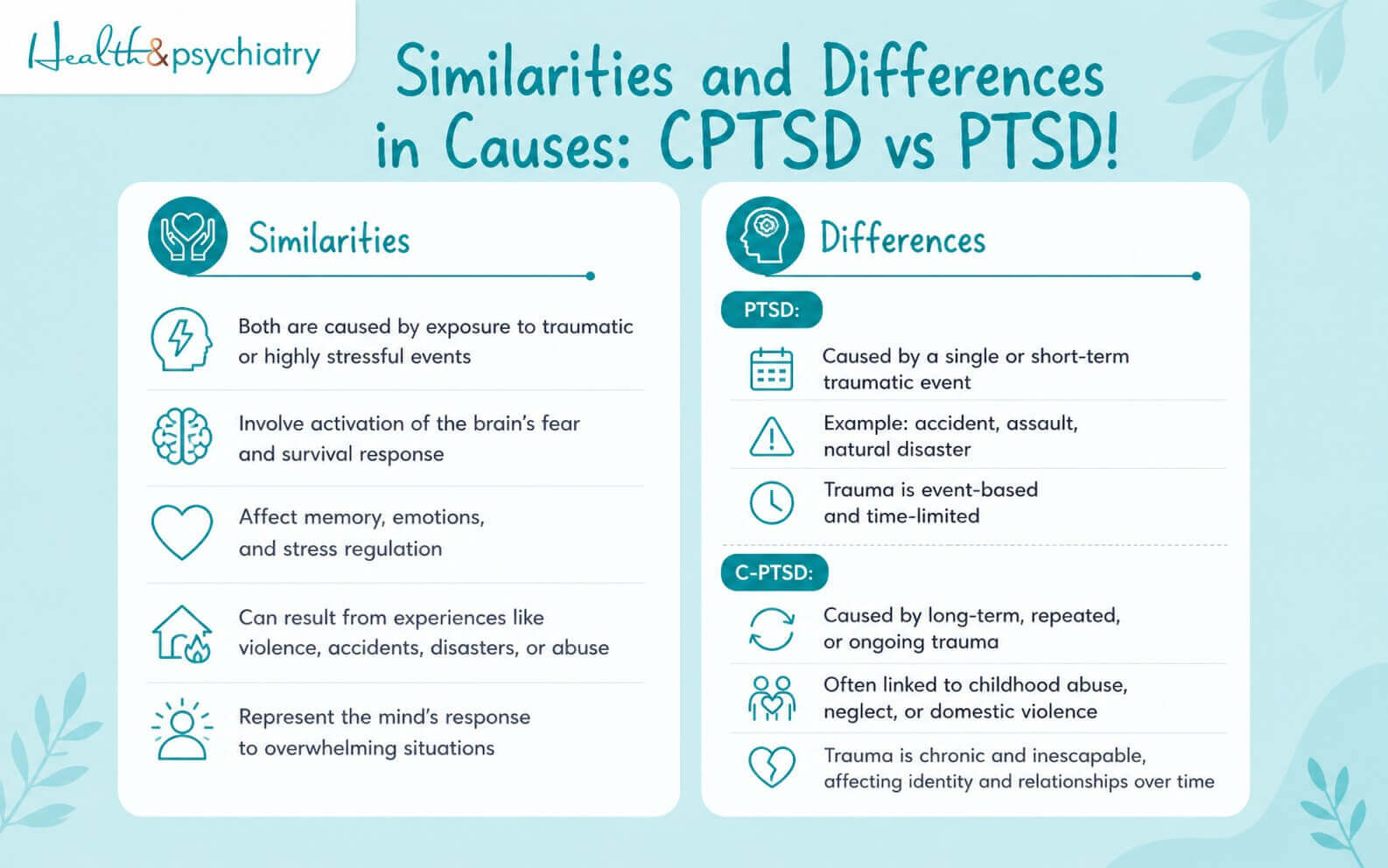
Similarities and Differences in Causes: CPTSD vs PTSD!
Both disorders are caused by traumatic experiences, and complex PTSD vs acute PTSD are different in the ways such trauma is experienced and in the ways such stress influences the emotional and psychological world of a person.
→ Similarities
The essence of both PTSD and C-PTSD is a reaction to trauma. Threat, harm, or extreme stress events may induce alterations in the fear processing and memory processing of the brain.
It can be a natural calamity or even domestic violence, but in both cases, these situations demonstrate the effort to adjust to excessive experiences on the part of the mind.
→ Differences
The major distinction is the way the trauma takes place during the course of time. People generally relate PTSD to an event or a temporary set of occurrences.
C-PTSD ot type 2 PTSD is, however, acquired because the trauma is prolonged and unavoidable, in most cases in childhood or in relationships when someone is expected to feel safe.
The National Institute of Mental Health states that early and repeated trauma is a significant risk factor for long-term psychological problems, such as complex trauma reactions.
C-PTSD vs PTSD Diagnosis
→ Diagnosing PTSD
In order to diagnose PTSD, one needs to locate some clusters of symptoms, determine the exposure to the trauma, and analyze the duration of the symptoms. Clinician-Administered PTSD Scale (CAPS) is often structured tools that assists clinicians in this process.
The diagnosis does not mean that a symptom needs to be more than a month in duration and needs to generate a significant disturbance in daily functioning.
→ Diagnosing CPTSD
Type 2 PTSD has been classified as a diagnosis in the ICD-11 system. In addition to PTSD diagnosis symptoms, clinicians evaluate emotional regulation issues, negative self-belief issues, and problems with disruptions of relationships.
A study found that the ICD-11 criteria can be used to create a more improved demarcation between PTSD and Complex PTSD to improve accuracy in diagnosing.
Symptoms where PTSD and CPTSD Intersect and Differ!

→ Overlapping Symptoms of Complex PTSD vs PTSD
The two conditions have a lot of overlap. Both entail the re-experience of traumatic events, avoiding triggers, hyper alertness or anxiety.
One of the reasons why c-ptsd was, at some point in history, lumped together with PTSD is this shared symptom profile.
Common overlapping symptoms include:
- Intrusive memories or flashbacks
- Nightmares related to the trauma
- Avoidance of triggers (people, places, situations)
- Hypervigilance (feeling constantly “on edge”)
- Anxiety and exaggerated startle response
- Emotional distress when reminded of the trauma
→ Key Differences PTSD vs CPTSD
The point of divergence of CPTSD is its wider effect. It not only influences the way one reacts to a trauma, but it also influences the perception of self and one of his or her interactions with others.
Although a person with acute PTSD can have a problem with fear and avoidance, a person with CPTSD might have another issue with a well-grounded feeling of shame and persistent problems with relationships.
PTSD (Typically)
- Fear-driven reactions to a specific traumatic event.
- Strong avoidance behaviors.
- Acute anxiety and hyperarousal.
- Reliving the trauma through flashbacks or nightmares.
C-PTSD (Additional & Distinct Symptoms)
- Persistent emotional dysregulation (intense anger, sadness, or numbness).
- Deep-rooted feelings of shame, guilt, or worthlessness.
- Negative self-concept (feeling “damaged” or fundamentally flawed).
- Difficulty forming or maintaining relationships.
- Trust issues and social withdrawal.
- Feeling disconnected from others or reality (dissociation).
- Chronic sense of helplessness or hopelessness.
Differences and Similarities in Treatments of PTSD & CPTSD

→ Treatment Approaches for PTSD
The treatment of PTSD is frequently organized, aimed at working on the traumatic memory. Strategies such as Cognitive Behavioral Therapy (CBT), Prolonged Exposure Therapy, & Eyes Movement Desensitization and Reprocessing (EMDR) have credible evidence.
The American Psychological Association emphasizes that trauma psychotherapies can be considered some of the best interventions in PTSD.
→ Effective Treatments for CPTSD
CPTSD can be treated in a more progressive and layered manner. The therapy is usually initiated by stabilization, which involves assisting the patient to gain control over her emotions and feel secure, and then proceeds to processing.
Since CPTSD has impacts on identity and interpersonal relationships, self-concept and interpersonal skills work can also be included in therapy. In the long-term, integrative strategies are more likely to work.
Research in Frontiers in Psychology indicates that multi-phase and long-term treatments are more effective in patients with complicated trauma histories.
→ Similarities in Treatment of C-PTSD & PTSD
The implementation of the PTSD and CPTSD treatment can have different structures and durations, yet the concepts of safety and trust and a gradual recovery are essential in both strategies.
Other important aspects of the two conditions are therapeutic relationships, psychoeducation and even medication (antidepressants).
Key shared treatment approaches include:
- Establishing safety and stability before processing trauma.
- Building a strong therapeutic relationship based on trust.
- Trauma-focused psychotherapy (e.g., CBT, EMDR).
- Psychoeducation to help individuals understand their symptoms.
- Gradual exposure to traumatic memories in a controlled way.
- Emotional regulation skills and coping strategies.
- Use of medication (such as antidepressants or anti-anxiety drugs) when needed.
- Encouraging support systems (family, support groups).
- Focus on long-term recovery and relapse prevention.
Quick Summary Table
|
Feature |
PTSD |
CPTSD |
|
Nature of trauma |
Single or short-term |
Prolonged and repeated |
|
Core symptoms |
Intrusion, avoidance, hyperarousal |
Same plus emotional and relational issues |
|
Self-image |
Largely preserved |
Often deeply negative |
|
Relationships |
May be affected |
Frequently disrupted |
|
Treatment |
Structured, often shorter-term |
Phased, longer-term |
Looking for Help with PTSD Disorder?
At Health & Psychiatry, you are able to access highly qualified mental health professionals to help with PTSD disorder from the comfort and privacy of your own home.
We offer a full range of services to support your mental health needs, including:
- Proper psychiatric evaluation.
- Medication management to help stabilize symptoms.
- Individual therapy and trauma-focused counseling.
- Comprehensive telepsychiatry evaluations.
- Ongoing mental health support and follow-ups.
Our approach focuses on helping you regain control, rebuild resilience, and improve your overall emotional well-being in a safe and supportive environment.
Book your consultation today… and take the first step toward recovery, healing, and a healthier, more balanced life.
FAQs
How does PTSD differ primarily from C-PTSD?
The key distinction is the length of and effect of the trauma. PTSD is typically associated with a single incident, whereas CPTSD evolves over a time span involving trauma and augmented troubles of emotional regulation, sense of identity and connections with others.
Is Complex PTSD (C-PTSD) more awful than PTSD?
CPTSD is not worse, but more complicated. It influences more spheres of the life of a person and this may slow down the recovery process and make it more complex to be treated.
Is it possible to be both with PTSD and CPTSD?
The deep-seated symptoms of PTSD are already present in CPTSD. In lieu of both being different diagnoses, CPTSD is believed to be a generalized condition that encompasses the features of PTSD and more.