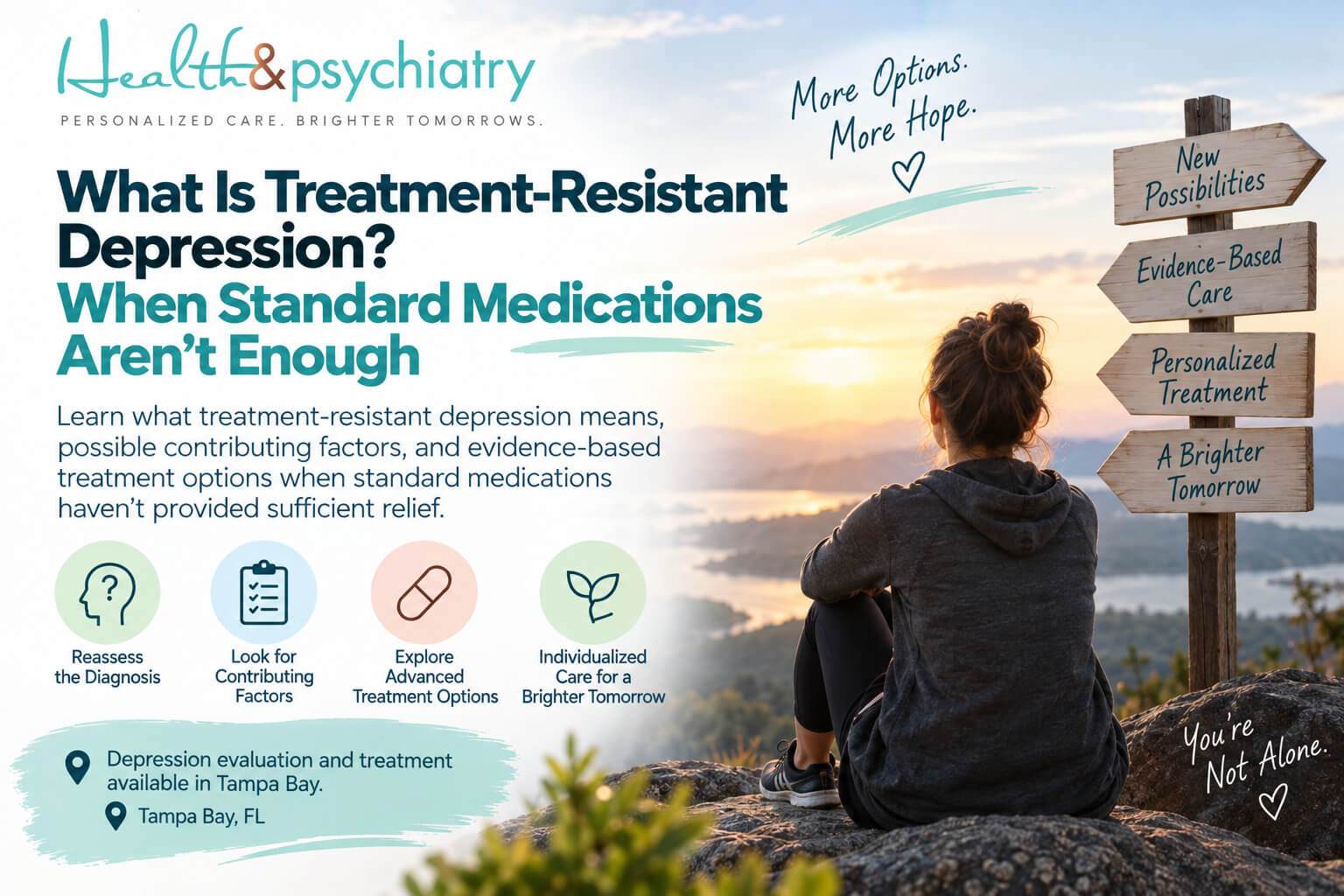
Treatment resistant depression generally describes major depressive disorder that has not improved sufficiently after multiple appropriate treatment attempts. A commonly used definition involves inadequate response to at least two antidepressant trials of adequate dose and duration, although definitions vary. Before applying this label, a psychiatrist should reassess the diagnosis, adherence, side effects, medical conditions, substances, sleep, psychotherapy, and previous treatment quality.
Tampa Bay adults with persistent symptoms can learn about individualized depression evaluation and treatment through Health & Psychiatry.
Key Takeaways
- Treatment-resistant depression does not mean that depression is untreatable.
- One unsuccessful antidepressant trial usually does not establish treatment resistance.
- Clinicians should verify the diagnosis, dose, duration, adherence, and previous response.
- Bipolar disorder, sleep disorders, medical conditions, and medication interactions may contribute to apparent resistance.
- Options may include medication optimization, psychotherapy, TMS, Spravato, ECT, or another individualized approach.
- Severe suicidal intent, psychosis, catatonia, or inability to remain safe requires urgent or emergency care.
What Is Treatment-Resistant Depression?
Treatment-resistant depression, sometimes abbreviated as TRD, is not a separate type of mood disorder with one universally accepted definition.
In clinical practice, the term often refers to major depressive disorder that has not responded adequately after at least two appropriate antidepressant trials. An appropriate trial generally requires consideration of:
- Correct diagnosis
- Clinically suitable medication
- Adequate dose
- Adequate duration
- Consistent use
- Tolerability
- Meaningful symptom measurement
- Functional improvement
Some clinicians prefer the term “difficult-to-treat depression” because persistent symptoms may result from several interacting factors rather than biological medication resistance alone.
The label should guide a more detailed evaluation—not communicate that the patient has run out of options.
What Does “Not Responding” Mean?
Treatment outcomes exist on a spectrum.
No Response
Symptoms show little or no meaningful improvement.
Partial Response
Some symptoms improve, but significant depression and impairment remain.
Response
Symptoms improve substantially, but the person may still experience residual difficulties.
Remission
Symptoms become minimal or absent, and functioning improves. Remission does not guarantee that depression will never return.
Relapse or Recurrence
Symptoms return after improvement. Clinicians distinguish between relapse within the same episode and a later recurrent episode based on timing and clinical history.
A medication may reduce sadness but leave fatigue, poor concentration, insomnia, or loss of pleasure. That partial improvement still matters, but it may not be enough to restore daily functioning.
Does One Antidepressant Failing Mean You Have Treatment-Resistant Depression?
Usually not.
The first antidepressant may not help because:
- The medication was not a good individual fit
- The dose was insufficient
- The trial ended too soon
- Side effects prevented consistent use
- Doses were frequently missed
- Another medication caused an interaction
- Alcohol or lifestyle habits affected treatment
- The diagnosis requires reconsideration
- An untreated medical condition contributed
- Psychosocial stress remained severe
- Depression improved partially but was not measured carefully
A psychiatrist should review what was actually tried before counting a medication as an unsuccessful treatment trial.
What Is Pseudoresistance?
“Pseudoresistance” describes depression that appears resistant even though the treatment or diagnosis has not been adequately established.
This term does not imply that symptoms are fake. The depression and impairment may be severe and entirely real.
| Possible contributor | Why it can resemble treatment resistance |
|---|---|
| Inadequate dose | Medication exposure may not have reached an effective level |
| Insufficient duration | The treatment may have ended before an appropriate assessment |
| Missed doses | Inconsistent exposure can prevent benefit or cause withdrawal symptoms |
| Intolerable side effects | The patient may be unable to follow the intended plan |
| Incorrect diagnosis | Bipolar disorder or another condition may require a different approach |
| Untreated sleep disorder | Poor sleep can sustain fatigue, cognitive symptoms, and low mood |
| Medical condition | Thyroid, anemia, pain, hormonal, or neurological factors may contribute |
| Medication interaction | Another drug or supplement may alter treatment or cause similar symptoms |
| Unaddressed trauma or stress | Medication alone may not resolve major environmental or psychological contributors |
Identifying one of these factors does not guarantee that correcting it will resolve depression. It helps create a more accurate treatment plan.
Why Might Standard Depression Treatment Not Be Enough?
Biological Differences
People differ in genetics, metabolism, brain function, medical history, and sensitivity to medication. A treatment that helps one patient may provide limited benefit or unacceptable side effects for another.
Incomplete Diagnosis
Depression can occur with or be confused with:
- Bipolar disorder
- Anxiety disorders
- ADHD
- PTSD
- Substance-related disorders
- Psychotic disorders
- Personality disorders
- Grief-related conditions
- Sleep disorders
- Medical illness
A person with bipolar depression may initially appear to have major depressive disorder if earlier mania or hypomania went unrecognized.
Co-Occurring Conditions
Anxiety, chronic pain, insomnia, and other conditions may intensify depression or interfere with treatment.
Treating only one part of the clinical picture may result in incomplete improvement.
Persistent Stress or Trauma
Medication may reduce depressive symptoms but cannot independently resolve:
- Abuse
- Housing instability
- Financial crisis
- Grief
- Workplace conflict
- Caregiving strain
- Isolation
- Relationship violence
- Ongoing trauma exposure
Treatment may need to include psychotherapy, safety planning, social services, family support, or practical interventions.
Residual Symptoms
Even after partial improvement, symptoms such as insomnia, anhedonia, fatigue, slowed thinking, and poor concentration may increase the risk of continuing impairment or symptom return.
Treatment Side Effects
A medication may help mood but cause:
- Sexual dysfunction
- Emotional blunting
- Weight changes
- Sleep problems
- Fatigue
- Nausea
- Restlessness
- Cognitive complaints
A plan is not fully successful if its adverse effects make treatment unsustainable.
How Is Treatment-Resistant Depression Evaluated?
A responsible evaluation should go beyond asking how many medications have been tried.
Confirming the Diagnosis
The psychiatrist reviews whether the symptom pattern supports major depressive disorder and whether another diagnosis may better explain it.
Questions may address:
- Previous mania or hypomania
- Psychotic symptoms
- Trauma
- Anxiety
- Attention difficulties
- Personality patterns
- Grief
- Sleep
- Medical symptoms
Reconstructing the Treatment History
Bring information about every previous treatment:
- Medication name
- Dose
- Duration
- Adherence
- Benefits
- Side effects
- Reason it was stopped
- Psychotherapy type and duration
- Hospital or intensive treatment
- TMS, Spravato, ECT, or other procedures
- Insurance or cost barriers
Pharmacy records and old clinical notes may help when exact details are difficult to remember.
Assessing Current Severity and Safety
The evaluation may examine:
- Depressed mood
- Loss of interest
- Sleep
- Appetite
- Energy
- Concentration
- Guilt or worthlessness
- Psychomotor changes
- Suicidal thoughts
- Daily functioning
- Ability to care for basic needs
Standardized symptom scales may help track change, but they do not replace clinical assessment.
Reviewing Medical Conditions
Depending on the history, coordination may involve:
- Physical examination
- Laboratory testing
- Thyroid assessment
- Blood counts
- Vitamin testing
- Metabolic review
- Sleep evaluation
- Neurological assessment
- Pregnancy-related care
- Chronic-pain treatment
Routine testing for every possible condition is not always necessary. The clinical history should guide the workup.
Reviewing Medication
The psychiatrist should know about:
- Prescription medications
- Over-the-counter medicines
- Supplements
- Alcohol
- Cannabis
- Stimulants
- Sedatives
- Opioids
- Recent medication changes
What Treatment Options May Be Considered?
There is no universal sequence that fits every patient.
| Treatment strategy | What it involves | Key consideration |
|---|---|---|
| Optimize current medication | Adjust dose or allow an appropriate duration | Benefits must be weighed against side effects |
| Switch medication | Transition to another antidepressant | Requires an individualized switching plan |
| Combine antidepressants | Use more than one antidepressant strategy | Adds interaction and side-effect considerations |
| Augmentation | Add a medication from another class | Selection depends on diagnosis and medical history |
| Psychotherapy | Add or modify an evidence-based therapy | Type, intensity, and therapeutic fit matter |
| TMS | Noninvasive magnetic brain stimulation | Requires repeated treatment sessions |
| Spravato | Supervised esketamine nasal-spray treatment | Requires clinic administration and post-dose monitoring |
| ECT | Procedure performed under anesthesia | May be considered for severe, urgent, or resistant illness |
| Higher-level care | Intensive outpatient, partial, residential, or hospital care | Determined by severity, safety, and functioning |
No table can determine individual candidacy.
Medication Optimization
Before abandoning a medication, a psychiatrist may consider whether it:
- Was taken consistently
- Was used at an appropriate dose
- Was taken long enough
- Produced partial benefit
- Caused dose-limiting side effects
- Interacted with another substance or medication
Possible strategies may include:
- Adjusting the dose
- Changing dosing time
- Switching antidepressants
- Combining selected treatments
- Adding an augmentation medication
- Treating a co-occurring condition
Do not change, combine, or discontinue psychiatric medication independently.
What Is Augmentation?
Augmentation means adding another treatment to an antidepressant that produced an incomplete response.
Depending on the patient, clinicians may consider certain:
- Atypical antipsychotic medications
- Mood-stabilizing medications
- Other antidepressant strategies
- Thyroid-related treatment in selected circumstances
- Psychotherapy
- Neuromodulation treatments
Each option has different evidence, risks, interactions, and monitoring requirements.
If bipolar disorder is suspected, the diagnostic assessment should occur before automatically adding or escalating an antidepressant.
Can Psychotherapy Help After Medication Has Not Worked?
Yes. Psychotherapy may remain valuable even after medication trials have produced limited improvement.
Potential approaches include:
- Cognitive behavioral therapy
- Behavioral activation
- Interpersonal psychotherapy
- Acceptance and commitment therapy
- Trauma-focused treatment when appropriate
- Family or relationship therapy
- Dialectical behavior therapy for selected needs
Psychotherapy may help patients:
- Reduce avoidance
- Rebuild meaningful activity
- Address negative thinking patterns
- Improve relationships
- Process trauma or grief
- Develop coping and relapse-prevention skills
- Improve treatment adherence
A therapy trial may be inadequate if sessions were too brief, infrequent, poorly matched to the problem, or ended before meaningful work occurred.
What Is TMS?
Transcranial magnetic stimulation is a noninvasive treatment that uses magnetic pulses to influence brain regions involved in mood regulation.
During treatment:
- The patient remains awake
- A magnetic coil is positioned against the scalp
- No surgical implant is placed
- General anesthesia is not used
- Treatment is delivered across repeated appointments
TMS may be considered for eligible adults whose depression has not improved sufficiently with previous treatment.
Potential short-term effects may include:
- Scalp discomfort
- Headache
- Tingling
- Temporary facial-muscle movement
Seizure is a rare but important risk. Implant, neurological, medication, and seizure-history screening is required.
TMS does not guarantee remission, and insurance criteria vary.
What Is Spravato?
Spravato is the brand name for esketamine nasal spray. It is not the same as unsupervised, compounded, or at-home ketamine products.
The FDA-approved 2025 prescribing information includes Spravato as monotherapy or in conjunction with an oral antidepressant for adults with treatment-resistant depression. It must be administered under direct healthcare supervision through a certified treatment setting.
Because of risks including sedation, dissociation, respiratory depression, abuse, and misuse:
- Patients self-administer it in the treatment setting
- Blood pressure and clinical status are monitored
- Observation is required after dosing
- Patients cannot drive until the next day after restful sleep
- The treatment is governed by an FDA Risk Evaluation and Mitigation Strategy
The current FDA-approved Spravato label provides the complete indication, warnings, contraindications, and monitoring requirements.
Spravato is not an emergency substitute and does not eliminate the need for comprehensive psychiatric care.
What Is ECT?
Electroconvulsive therapy is performed under general anesthesia. Controlled electrical stimulation produces a brief seizure.
ECT may be considered when depression is:
- Severe
- Psychotic
- Associated with catatonia
- Creating urgent safety or medical concerns
- Not responding to other appropriate treatment
- Requiring a faster clinical response
Potential risks include temporary confusion, headache, muscle soreness, and memory effects. The treatment team should explain anesthesia risks, cognitive considerations, expected schedule, alternatives, and follow-up care.
How Do TMS, Spravato, and ECT Compare?
| Feature | TMS | Spravato | ECT |
|---|---|---|---|
| Treatment type | Magnetic brain stimulation | Esketamine nasal spray | Electrical stimulation under anesthesia |
| Conscious during treatment | Yes | Yes, with supervision | No; general anesthesia is used |
| Invasive surgery | No | No | No surgery, but anesthesia and seizure induction are required |
| Clinic monitoring | Required during sessions | Required during and after each dose | Required before, during, and after procedure |
| Typical use | Depression not improved sufficiently with previous care | Eligible adults with treatment-resistant depression | Severe, urgent, psychotic, catatonic, or resistant depression |
| Main practical issue | Repeated treatment visits | Post-dose observation and transportation | Anesthesia, recovery, and cognitive considerations |
| Guaranteed outcome | No | No | No |
A psychiatrist must determine whether any of these treatments is clinically appropriate.
What About Ketamine Infusions?
Intravenous ketamine may be used off-label by some medical practices for depression. It is different from FDA-approved intranasal esketamine.
Important distinctions include:
- Different formulation
- Different administration route
- Different regulatory status
- Different protocols
- Different monitoring systems
- Different insurance coverage
Patients considering ketamine-based treatment should ask about the prescriber’s qualifications, emergency procedures, monitoring, dosing protocol, evidence, risks, and follow-up care.
Can Pharmacogenetic Testing Identify the Right Antidepressant?
Pharmacogenetic testing may provide information about how genetic variants affect the metabolism or tolerability of certain medications.
It cannot reliably:
- Diagnose depression
- Prove that a medication will work
- Select a guaranteed treatment
- Replace a psychiatric evaluation
- Account for every interaction or medical factor
The Mayo Clinic’s treatment-resistant depression guidance notes that pharmacogenetic tests may provide clues in selected cases but are not a sure way to identify an effective medication.
Testing should be interpreted within the complete clinical picture.
Does Treatment-Resistant Mean Untreatable?
No.
The term means that previous treatments did not provide sufficient benefit under the definition being used. It does not predict that every future treatment will fail.
A more useful question is:
What factors have not yet been adequately evaluated or addressed?
The answer may involve:
- Diagnostic clarification
- Better documentation of previous trials
- Side-effect management
- Medical treatment
- Sleep evaluation
- Different psychotherapy
- Medication adjustment
- TMS
- Spravato
- ECT
- More intensive care
Progress may involve full remission, partial symptom improvement, restored functioning, fewer crises, or a combination of outcomes.
When Is Higher-Level Care Needed?
Routine outpatient treatment may not be sufficient when a person has:
- Imminent suicidal intent
- A recent suicide attempt
- Inability to eat or drink
- Severe self-neglect
- Psychosis
- Catatonia
- Severe agitation
- Dangerous substance withdrawal
- Inability to remain safe
- Rapid clinical deterioration
Call 911 or go to the nearest emergency room if there is an immediate risk of harm or another life-threatening emergency.
In the United States, call or text 988 for crisis support.
How Should You Prepare for a Treatment-Resistant Depression Consultation?
Bring:
- Current medication list
- Previous medication names
- Approximate doses
- Duration of each trial
- Benefits and side effects
- Reason each treatment ended
- Pharmacy records if available
- Psychotherapy history
- Hospital or intensive-treatment history
- Previous TMS, Spravato, ketamine, or ECT records
- Medical conditions
- Laboratory results
- Sleep history
- Family psychiatric history
- Insurance information
- Current treatment goals
A clear treatment timeline can prevent an inadequate or poorly tolerated trial from being misclassified.
Treatment-Resistant Depression Care in Tampa Bay
Health & Psychiatry provides depression evaluations and treatment from its clinic at:
3919 Tampa Road, First Floor
Oldsmar, FL 34677
The clinic serves adults from Oldsmar and surrounding Tampa Bay communities, including Clearwater, Palm Harbor, Safety Harbor, Westchase, and nearby areas.
An evaluation may help clarify:
- Whether previous medication trials were adequate
- Whether the diagnosis requires reassessment
- Whether bipolar symptoms are present
- Whether sleep, medical conditions, substances, or interactions contribute
- Whether psychotherapy should be added or changed
- Whether medication optimization is appropriate
- Whether TMS or Spravato deserves consideration
- Whether a higher level of care is necessary
You do not have to decide alone whether your depression is “resistant.” A consultation can review the evidence and identify reasonable next steps.
Frequently Asked Questions
It commonly describes major depressive disorder that has not improved sufficiently after at least two appropriate antidepressant trials, although definitions vary. A comprehensive reassessment is needed before applying the label.
Two adequate antidepressant trials are commonly used as a threshold, but clinicians also examine dose, duration, adherence, diagnosis, side effects, psychotherapy, and functional outcomes.
No. It means previous treatment has not provided sufficient improvement. Medication strategies, psychotherapy, TMS, Spravato, ECT, diagnostic clarification, or treatment of contributing conditions may still be considered.
Yes. Bipolar depression can resemble major depression, particularly when previous mania or hypomania went unrecognized. Diagnostic reevaluation is important when treatment response is unusual or incomplete.
TMS may be considered for eligible patients whose depression has not improved sufficiently with previous treatment. Candidacy requires diagnostic and safety screening, and coverage criteria vary.
Yes. FDA-approved esketamine nasal spray may be used as monotherapy or with an oral antidepressant for eligible adults with treatment-resistant depression. It requires supervised administration and post-dose monitoring in a certified setting.
No. Spravato is FDA-approved intranasal esketamine with specific supervision and REMS requirements. Intravenous or compounded ketamine involves different formulations, routes, protocols, and regulatory status.
ECT may be considered for severe, psychotic, catatonic, urgent, or treatment-resistant depression. The decision requires evaluation of benefits, anesthesia, memory considerations, alternatives, and medical risks.
Health & Psychiatry provides depression evaluations and advanced-treatment consultations at its Oldsmar clinic. Tampa Bay adults can request an appointment online.
Explore Your Next Depression Treatment Options
Treatment resistant depression does not mean that your symptoms are imaginary, that you failed treatment, or that no options remain.
The next step is a careful review of the diagnosis, previous treatments, medical history, sleep, substances, side effects, and daily functioning. From there, a psychiatrist can discuss medication strategies, psychotherapy, TMS, Spravato, ECT, or another appropriate level of care.
Medical Disclaimer
This article provides general education. It does not diagnose treatment-resistant depression, establish eligibility for TMS, Spravato, ECT, or another treatment, and does not replace individualized medical advice. Benefits, risks, insurance requirements, and outcomes vary.