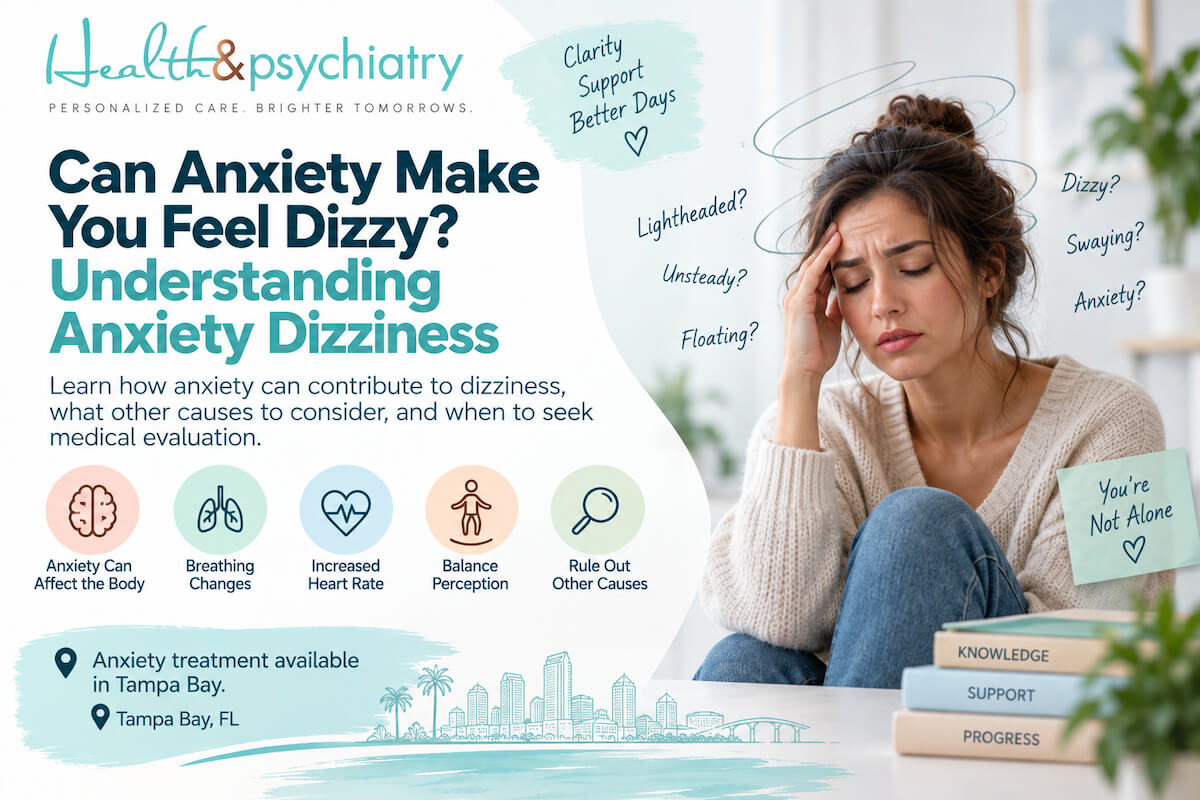
Yes. Anxiety dizziness may feel like lightheadedness, unsteadiness, floating, swaying, or a sense that you might faint. Anxiety can affect breathing, heart rate, muscle tension, attention, and balance perception. However, dizziness also has many medical causes. New, persistent, severe, or unexplained dizziness—especially with neurological, cardiac, or hearing symptoms—requires appropriate medical evaluation.
Tampa Bay adults experiencing persistent anxiety and physical symptoms can learn about anxiety treatment at Health & Psychiatry.
Key Takeaways
- Anxiety and panic attacks can include dizziness or lightheadedness.
- “Dizziness” may describe faintness, imbalance, floating, or true spinning vertigo.
- Dizziness should not automatically be attributed to anxiety before other causes are considered.
- Rapid breathing during anxiety may contribute to lightheadedness and tingling.
- Fear of dizziness can create a cycle of symptom monitoring, avoidance, and increasing anxiety.
- Sudden dizziness with weakness, speech difficulty, chest pain, fainting, or a severe headache requires emergency care.
Can Anxiety Cause Dizziness?
Anxiety can produce real physical symptoms. When the body’s threat-response system becomes activated, changes may occur in:
- Breathing
- Heart rate
- Blood pressure
- Muscle tension
- Visual attention
- Balance perception
- Digestion
- Sensitivity to bodily sensations
Dizziness can occur during generalized anxiety, panic attacks, situational anxiety, health anxiety, or periods of severe stress.
The National Institute of Mental Health includes weakness or dizziness among possible physical symptoms of panic attacks.
That does not mean every dizzy episode is psychiatric. Anxiety may cause dizziness, worsen dizziness from another condition, or develop because unexplained dizziness feels frightening.
What Does Anxiety Dizziness Feel Like?
People use “dizziness” to describe several different sensations.
Anxiety-related experiences may include:
- Feeling lightheaded
- Feeling faint without losing consciousness
- A floating sensation
- Swaying or rocking
- Feeling unsteady while walking
- Feeling disconnected from the surroundings
- A heavy or foggy head
- Visual sensitivity
- Difficulty concentrating
- Feeling as though the floor is moving
- Brief disorientation during panic
- A sense that the body is unreal or distant
Describe the sensation precisely during an appointment. The distinction between lightheadedness, imbalance, and spinning can help guide evaluation.
Lightheadedness vs Vertigo vs Imbalance
| Sensation | Typical description | Possible causes |
|---|---|---|
| Lightheadedness | “I might faint” or “my head feels empty” | Anxiety, rapid breathing, dehydration, low blood pressure, low blood sugar, medication effects, cardiac conditions |
| Vertigo | “I am spinning” or “the room is moving” | Inner-ear disorders, migraine, neurological conditions, medication effects |
| Imbalance | “I feel unstable while standing or walking” | Vestibular, neurological, visual, medication-related, or musculoskeletal causes |
| Floating or swaying | “I feel as if I am on a boat” | Anxiety, vestibular conditions, migraine, persistent postural-perceptual dizziness |
| Dissociation | “I feel unreal or disconnected” | Panic, trauma-related symptoms, severe stress, other psychiatric or medical causes |
The National Library of Medicine’s MedlinePlus distinguishes lightheadedness—a sense that you might faint—from vertigo, in which you or the environment appears to move or spin.
Why Can Anxiety Make You Feel Dizzy?
Rapid or Shallow Breathing
Anxiety may change breathing before the person notices it.
Breathing too rapidly or deeply can lower carbon dioxide levels in the blood and contribute to:
- Lightheadedness
- Tingling around the mouth or hands
- Chest tightness
- Muscle spasms
- Feelings of unreality
- Increased fear
Trying to take repeated large “deep breaths” can sometimes intensify overbreathing. A slower, gentler breathing pattern may be more appropriate than forceful inhalation.
Breathing symptoms should not automatically be treated as anxiety if there is severe shortness of breath, chest pain, fainting, or another concerning medical symptom.
Changes in Heart Rate and Circulation
Anxiety can increase heart rate and alter the sensation of circulation. A person may become highly aware of:
- Heart pounding
- Palpitations
- Warmth
- Sweating
- Weakness
- Lightheadedness
Heart symptoms deserve medical assessment when they are new, severe, persistent, associated with fainting, or occur in someone with cardiovascular risk.
Muscle Tension
Anxiety may tighten muscles in the:
- Neck
- Shoulders
- Jaw
- Face
- Back
Muscle tension can contribute to headache, visual discomfort, altered posture, and a sense of imbalance. However, neck tension should not be assumed to explain persistent dizziness without an evaluation.
Heightened Attention to Body Sensations
Anxiety can make ordinary or minor sensations feel urgent.
The person may repeatedly monitor:
- Balance
- Vision
- Heart rate
- Breathing
- Head pressure
- Leg stability
- The possibility of fainting
This monitoring can make the sensation more noticeable and frightening, even when it began for another reason.
Visual and Environmental Sensitivity
Busy stores, crowds, patterned floors, scrolling screens, traffic, and bright lights can produce sensory overload or increase dizziness in some people.
These symptoms may occur with anxiety, migraine, vestibular disorders, or persistent postural-perceptual dizziness. The trigger alone does not establish the cause.
Poor Sleep and Fatigue
Anxiety may interfere with sleep, while inadequate sleep can worsen:
- Concentration
- Balance
- Visual processing
- Headache
- Irritability
- Sensitivity to motion
- Physical anxiety
The interaction can create a cycle in which poor sleep increases dizziness and dizziness makes it harder to relax.
The Anxiety-Dizziness Cycle
Anxiety and dizziness can reinforce each other:
- A person notices dizziness.
- The sensation is interpreted as dangerous.
- Fear increases heart rate, breathing changes, and muscle tension.
- Physical symptoms become more intense.
- The person monitors the body more closely.
- Avoidance and anticipatory anxiety develop.
- Future dizziness feels even more threatening.
This cycle does not mean the original symptom was imagined. Dizziness may begin with anxiety, a medical condition, or a combination of factors.
Treatment should address both the symptom and the fear surrounding it when appropriate.
Is Anxiety Dizziness the Same as a Panic Attack?
Not always.
Dizziness can occur as part of a panic attack, but it may also occur during chronic anxiety without a sudden panic episode.
A panic attack often involves an abrupt surge of fear or discomfort with symptoms such as:
- Racing heart
- Sweating
- Trembling
- Shortness of breath
- Chest discomfort
- Nausea
- Dizziness
- Tingling
- Chills or heat sensations
- Fear of losing control
- Fear of dying
- Feelings of unreality
One panic attack does not automatically mean someone has panic disorder. Panic disorder involves recurrent unexpected attacks together with persistent concern or behavioral changes related to future attacks.
What Else Can Cause Dizziness?
Dizziness has many possible causes.
Inner-Ear and Vestibular Conditions
Examples include:
- Benign paroxysmal positional vertigo
- Vestibular neuritis
- Labyrinthitis
- Ménière’s disease
- Other balance-system disorders
Clues may include spinning, symptoms triggered by head movement, ringing in the ears, ear pressure, or hearing changes.
Migraine
Vestibular migraine can cause dizziness, motion sensitivity, visual sensitivity, or vertigo—with or without a prominent headache.
Blood-Pressure Changes
A sudden drop in blood pressure when standing may cause lightheadedness or near-fainting.
Dehydration and Heat
Inadequate fluids, vomiting, diarrhea, fever, heavy sweating, or heat exposure may contribute to dizziness.
Low Blood Sugar
Low blood glucose can cause dizziness, sweating, trembling, weakness, confusion, and other symptoms.
Anemia
Reduced oxygen-carrying capacity may contribute to fatigue, weakness, shortness of breath, or lightheadedness.
Heart Conditions
Abnormal heart rhythms and other cardiovascular problems may cause dizziness, palpitations, chest discomfort, shortness of breath, or fainting.
Neurological Conditions
Stroke, transient ischemic attack, seizure, multiple sclerosis, head injury, and other neurological conditions may cause dizziness. Associated symptoms and the timing of onset matter.
Medication Effects
Dizziness may occur with:
- Some antidepressants
- Anti-anxiety or sedating medications
- Blood-pressure medications
- Antihistamines
- Anti-seizure medications
- Sleep medications
- Other prescriptions or supplements
Do not stop medication independently. Ask the prescriber to review symptom timing, dose changes, interactions, and alternatives.
Alcohol and Other Substances
Alcohol, cannabis, sedatives, stimulants, and withdrawal states may affect balance, blood pressure, perception, anxiety, and coordination.
When Is Dizziness a Medical Emergency?
Call 911 or seek emergency care for new or severe dizziness accompanied by:
- Facial drooping
- Weakness or numbness
- Difficulty speaking
- Confusion
- Double vision or sudden visual changes
- Inability to walk
- Loss of coordination
- A sudden severe headache
- Chest pain
- Rapid or irregular heartbeat
- Severe shortness of breath
- Fainting
- Seizure
- Ongoing vomiting
- Sudden hearing loss
- Recent serious head injury
- Loss of consciousness
The Mayo Clinic’s dizziness guidance recommends emergency care for new, severe dizziness with symptoms such as chest pain, neurological changes, trouble breathing, fainting, seizures, or ongoing vomiting.
Do not assume that sudden neurological or cardiac symptoms are caused by anxiety.
When Should You Schedule a Nonemergency Medical Evaluation?
Contact a healthcare professional when dizziness:
- Occurs for the first time
- Keeps returning
- Begins suddenly without a clear explanation
- Lasts a long time
- Continues to worsen
- Interferes with walking or driving
- Follows a medication change
- Occurs with hearing loss or ringing
- Is triggered by position changes
- Causes falls
- Interferes with work or daily activities
- Occurs during pregnancy
- Happens with palpitations or near-fainting
A primary-care clinician may be an appropriate starting point when the cause is unclear. Depending on the findings, evaluation by an ear, neurological, cardiac, vestibular, or psychiatric specialist may be appropriate.
How Is Dizziness Evaluated?
A clinician may ask:
- What does the dizziness feel like?
- When did it begin?
- How long does each episode last?
- Is it constant or episodic?
- Does head movement trigger it?
- Does standing trigger it?
- Is there hearing loss or ringing?
- Does it occur during fear or panic?
- Are there headaches or visual symptoms?
- Have you fainted?
- Did it begin after a medication change?
- Do you use alcohol or other substances?
- What other symptoms occur at the same time?
Possible assessment may include:
- Blood pressure while lying and standing
- Heart-rate assessment
- Neurological examination
- Ear and hearing evaluation
- Balance testing
- Electrocardiogram
- Laboratory testing
- Medication review
- Imaging when clinically indicated
- Anxiety and panic assessment
Testing depends on the symptom pattern. Not every patient needs every test.
How Is Anxiety-Related Dizziness Evaluated?
After relevant medical causes have been considered, a psychiatric evaluation may review:
- Worry and fear
- Panic attacks
- Avoidance
- Health anxiety
- Trauma symptoms
- Depression
- Sleep
- Lifestyle habits
- Medication effects
- Functional impairment
- Safety concerns
The clinician may ask whether dizziness occurs:
- During stressful situations
- Before or during panic
- In crowded or visually busy environments
- When focusing closely on bodily sensations
- After poor sleep
- Alongside rapid breathing or tingling
- When leaving home or entering feared places
A close relationship with anxiety supports treatment planning but does not prove that anxiety is the only cause.
How Is Anxiety Dizziness Treated?
Treatment depends on the diagnosis and whether another medical or vestibular condition is present.
Cognitive Behavioral Therapy
CBT may help a patient:
- Understand the anxiety-dizziness cycle
- Reconsider catastrophic interpretations
- Reduce symptom checking
- Gradually face avoided situations
- Develop more balanced responses to physical sensations
- Improve coping with uncertainty
For panic disorder, treatment may include interoceptive exposure—carefully and systematically approaching feared bodily sensations under appropriate clinical guidance.
The NIMH identifies CBT as a well-supported psychotherapy for panic disorder.
Medication
Medication may be considered for an anxiety disorder depending on:
- Diagnosis
- Symptom severity
- Medical history
- Previous treatment
- Side effects
- Current prescriptions
- Pregnancy
- Patient preference
Medication is not required for every patient and cannot substitute for evaluating unexplained dizziness.
Some psychiatric medications can initially cause dizziness or other side effects. The prescriber should explain what to monitor and when to report symptoms.
Breathing Skills
When overbreathing contributes, slower and gentler breathing may help reduce lightheadedness.
A simple approach may include:
- Sit somewhere safe.
- Relax the shoulders and jaw.
- Breathe gently through the nose.
- Allow the exhale to be slightly longer than the inhale.
- Avoid repeated forceful or oversized breaths.
- Stop and seek medical help if symptoms are severe or unusual.
Breathing exercises should not delay evaluation of chest pain, severe breathing difficulty, fainting, or neurological symptoms.
Gradual Reduction of Avoidance
Avoiding stores, driving, exercise, or leaving home may provide temporary relief but strengthen fear over time.
A therapist can help create a gradual exposure plan that accounts for:
- Medical safety
- Fall risk
- Vestibular conditions
- Panic symptoms
- The person’s pace and goals
Sleep and Routine Support
Treatment may also address:
- Consistent sleep
- Hydration
- Regular meals
- Caffeine use
- Alcohol and wellbeing
- Physical activity when medically appropriate
- Screen or visual triggers
- Medication adherence
These strategies support care but are not substitutes for diagnosis.
Vestibular Treatment
When an inner-ear or balance condition contributes, vestibular rehabilitation or another condition-specific treatment may be recommended.
Mental-health and vestibular treatment can occur together when anxiety and balance symptoms reinforce each other.
What Can You Do During a Dizzy Episode?
If symptoms are familiar, mild, and not accompanied by emergency warning signs:
- Sit or lie down
- Avoid driving
- Hold a stable surface
- Move slowly
- Reduce visual stimulation
- Breathe gently
- Notice whether you skipped food or fluids
- Record the trigger, duration, and associated symptoms
- Follow the plan provided by your healthcare professional
Do not drive, climb, or operate machinery while dizzy.
What Should You Track?
A brief symptom record may include:
| Detail | What to record |
|---|---|
| Sensation | Lightheaded, spinning, swaying, unsteady, or faint |
| Timing | Start time and duration |
| Position | Lying, sitting, standing, walking, or turning the head |
| Trigger | Stress, crowd, driving, screen, heat, exercise, or no clear trigger |
| Other symptoms | Headache, hearing change, palpitations, tingling, nausea, or weakness |
| Anxiety | Fear level before and after dizziness began |
| Medication | Dose, timing, missed doses, or recent changes |
| Sleep and intake | Sleep duration, meals, caffeine, alcohol, and hydration |
This information can help a clinician identify patterns without encouraging constant body monitoring.
Anxiety Treatment in Tampa Bay
Health & Psychiatry provides anxiety evaluations and individualized treatment from its clinic at:
3919 Tampa Road, First Floor
Oldsmar, FL 34677
The clinic serves adults from Oldsmar and surrounding Tampa Bay communities, including Clearwater, Palm Harbor, Safety Harbor, Westchase, and nearby areas.
A psychiatric evaluation may help determine:
- Whether symptoms fit an anxiety disorder
- Whether panic attacks contribute
- Whether medication could be causing dizziness
- Whether sleep or lifestyle habits worsens symptoms
- Whether medical coordination is needed
- Whether psychotherapy or medication deserves consideration
- How dizziness-related fear and avoidance affect daily life
The goal is not to dismiss dizziness as “just anxiety.” It is to understand the complete symptom pattern and identify appropriate next steps.
Frequently Asked Questions
Anxiety may contribute to prolonged lightheadedness, swaying, or unsteadiness, but all-day dizziness should not automatically be attributed to anxiety. Persistent symptoms deserve medical evaluation.
It may feel like lightheadedness, floating, swaying, imbalance, fogginess, near-fainting, or disconnection. True spinning vertigo can have other causes and should be evaluated appropriately.
Rapid breathing, heart-rate changes, muscle tension, and heightened attention to physical sensations may contribute. Panic attacks can include dizziness, but new or severe symptoms still require appropriate assessment.
It may last minutes during an acute panic episode or recur over longer periods when anxiety remains active. Duration alone cannot determine the cause.
Anxiety can worsen the perception and distress of vertigo, but true spinning vertigo commonly involves vestibular, migraine-related, medication, or neurological causes. Medical evaluation may be appropriate.
Timing, triggers, associated symptoms, examination, and testing may help distinguish the cause. Sudden neurological changes, chest pain, fainting, severe headache, or difficulty walking requires urgent care.
Some psychiatric medications may cause dizziness, particularly after starting treatment or changing the dose. Do not stop medication independently; discuss the timing and severity with the prescriber.
Primary care may be an appropriate starting point for new or unexplained dizziness. A psychiatrist can evaluate anxiety, panic, medication effects, and psychiatric contributors, often in coordination with other clinicians.
Health & Psychiatry provides anxiety evaluation and treatment at its Oldsmar clinic. Tampa Bay adults can request an appointment online.
Get Help for Anxiety Dizziness in Tampa Bay
Anxiety dizziness is real, but anxiety is only one possible explanation for lightheadedness, imbalance, or vertigo.
If symptoms persist, recur, worsen, or interfere with daily life, appropriate medical and psychiatric evaluation can help clarify the likely contributors. You do not have to determine the cause by yourself.
Crisis Support
If you or someone else may be in immediate danger, call 911 or go to the nearest emergency room. Call or text 988 in the United States for crisis support.
Medical Disclaimer
This content is for general education. It does not diagnose anxiety, panic disorder, vertigo, or another condition and cannot determine the cause of dizziness. New, severe, persistent, or unexplained symptoms may require medical evaluation.