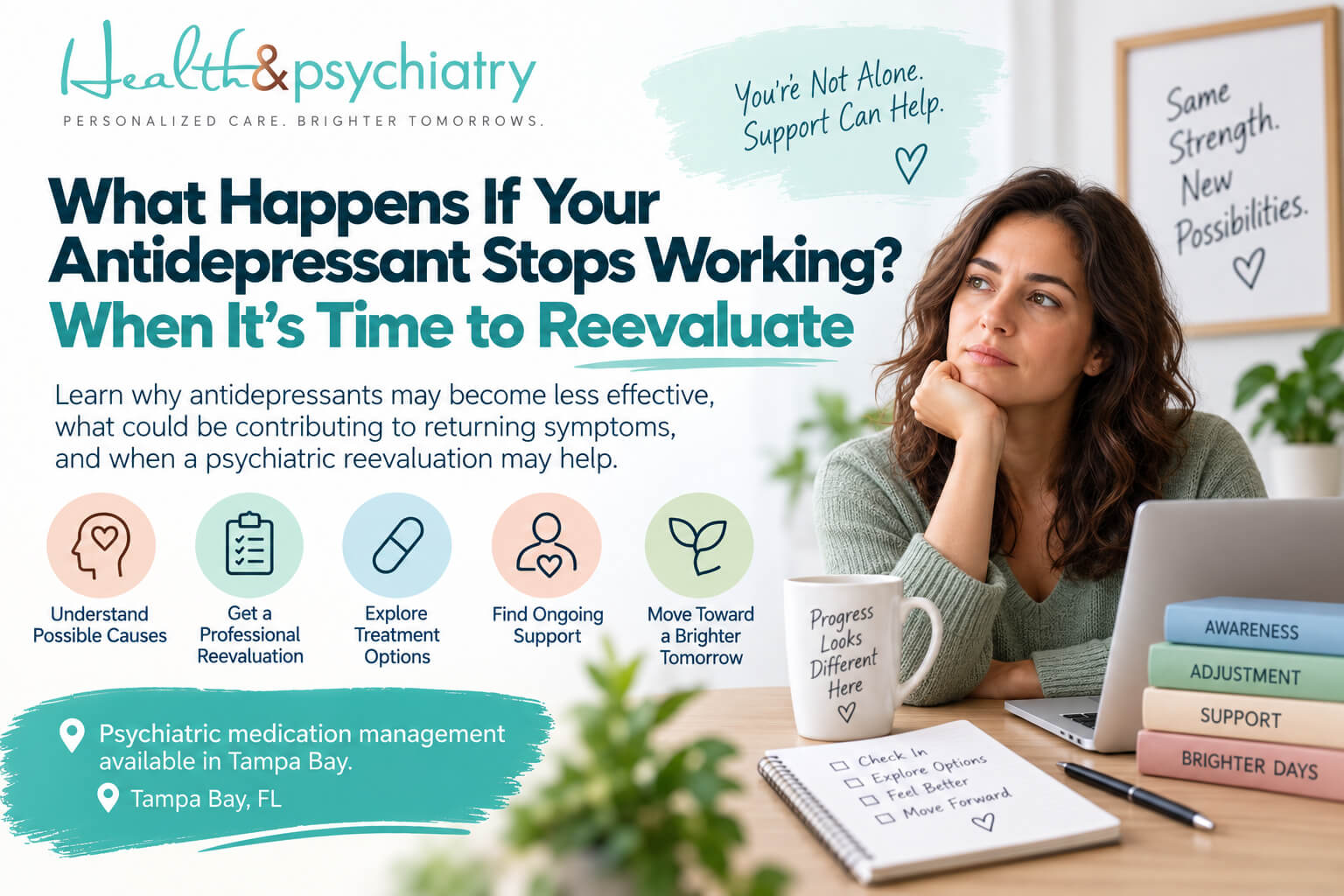
If your antidepressant stopped working, do not increase, skip, or discontinue it independently. Returning symptoms may reflect a new depressive episode, missed doses, stress, sleep disruption, medication interactions, hormonal or medical changes, an inaccurate diagnosis, or possible loss of response. A psychiatric reevaluation can identify likely contributors and determine whether monitoring, psychotherapy, dose optimization, switching, augmentation, or another treatment deserves consideration.
Tampa Bay adults experiencing returning symptoms can request individualized psychiatric medication management through Health & Psychiatry.
Key Takeaways
- A return of symptoms does not always mean the medication itself suddenly failed.
- Missed doses or abrupt discontinuation can cause symptoms that resemble relapse.
- New mania, psychosis, suicidal thoughts, or inability to remain safe requires prompt or emergency care.
- Do not change the dose or stop an antidepressant without guidance from the prescribing clinician.
- Reevaluation should cover diagnosis, adherence, dose, duration, side effects, other medications, substances, sleep, stress, and medical conditions.
- Several treatment pathways may be available, but none can guarantee a particular outcome.
Can an Antidepressant Stop Working?
Yes. Some people experience improvement with an antidepressant and later notice that depression symptoms return. Clinicians may describe this as:
- Loss of antidepressant response
- Breakthrough depression
- Depressive relapse or recurrence
- Antidepressant tachyphylaxis
“Tachyphylaxis” generally refers to a reduced response to a medication that previously helped while the person continues taking it. The informal term “antidepressant poop-out” is also used, but it can oversimplify the situation.
Symptoms may return for many reasons. A psychiatrist should not assume that medication tolerance is responsible before reviewing the complete clinical picture.
The Mayo Clinic identifies several possible contributors, including increased depression severity, another medical condition, new medication, age-related changes, pregnancy, and bipolar disorder.
What Are the Signs Your Antidepressant May No Longer Be Helping Enough?
Possible warning signs include:
- Persistent low or irritable mood
- Loss of interest or pleasure
- Reduced energy
- Increased fatigue
- Difficulty concentrating
- Changes in sleep
- Changes in appetite or weight
- Withdrawal from family or friends
- Reduced work or school performance
- Feelings of worthlessness
- Hopelessness
- Increased anxiety
- Thoughts of death or suicide
The most useful warning signs are often the symptoms that appeared before your previous depressive episode.
For one person, the first sign may be waking several hours too early. For another, it may be withdrawing socially, struggling to work, becoming unusually irritable, or losing interest in previously meaningful activities.
The National Institute of Mental Health explains that depression can affect mood, thinking, sleep, eating, work, and other daily activities.
Does One Bad Day Mean the Medication Stopped Working?
No. Antidepressants do not prevent every difficult emotion or stressful day.
Temporary mood changes may follow:
- Conflict
- Grief
- Poor sleep
- Illness
- Work stress
- Financial problems
- Relationship difficulties
- Hormonal changes
- A major life transition
A clinical review becomes more important when symptoms:
- Persist rather than passing
- Continue to worsen
- Resemble a previous depressive episode
- Affect work, relationships, or self-care
- Occur despite taking medication consistently
- Include concerning behavioral or safety changes
You do not need to wait until symptoms become severe before contacting your provider.
Why Might an Antidepressant Seem to Stop Working?
A New Depressive Episode
The medication may have helped during an earlier episode, but depression can recur. A new episode may differ in severity, triggers, or symptom pattern.
A recurrence does not automatically establish medication tolerance. The illness itself may have changed or become more active.
Missed or Inconsistent Doses
Missing doses can reduce medication exposure and may cause either returning symptoms or discontinuation effects.
Common reasons include:
- Forgetting doses
- Running out of medication
- Pharmacy delays
- Insurance problems
- Traveling
- Taking the medication only on difficult days
- Stopping because of side effects
- Changing the dose without guidance
Tell your provider honestly how the medication has been taken. Accurate information supports safer decisions.
Discontinuation Symptoms
Reducing or stopping certain antidepressants—particularly abruptly—may produce symptoms such as:
- Dizziness
- Nausea
- Headache
- Flu-like feelings
- Sleep disturbance
- Irritability
- Anxiety
- Vivid dreams
- Imbalance
- Unusual sensory sensations
Discontinuation symptoms and depression relapse can overlap, but they are not necessarily the same.
| Pattern | Possible discontinuation effect | Possible depressive relapse |
|---|---|---|
| Timing | Often begins after missed doses or dose reduction | May emerge without a medication change |
| Physical symptoms | Dizziness, nausea, imbalance, flu-like feelings may occur | Physical slowing, fatigue, and sleep changes may occur |
| Unusual sensations | “Electric” or shock-like sensations can occur | Less characteristic of depressive relapse |
| Emotional symptoms | Anxiety and irritability may appear | Low mood, hopelessness, and loss of interest may return |
| Course | May change after medication is resumed or taper is modified | Often requires broader reassessment |
This table is not diagnostic. Contact the prescriber rather than attempting to distinguish the conditions alone.
A Dose or Treatment Trial That Was Never Fully Optimized
Sometimes a person experiences partial benefit but continues to have significant symptoms. The issue may involve:
- An insufficient dose
- An inadequate treatment duration
- Dose-limiting side effects
- Irregular adherence
- Unclear treatment goals
- Lack of systematic symptom monitoring
Increasing the dose is not always appropriate. The safe range, benefits, and risks differ between medications and patients.
New Stress or Loss
Medication cannot eliminate every response to grief, trauma, relationship conflict, job loss, caregiving strain, or another major stressor.
Returning symptoms may indicate that psychotherapy, social support, safety planning, or environmental changes should become a larger part of treatment.
Sleep Problems
Insomnia, irregular sleep, shift work, insufficient sleep, and untreated sleep apnea may worsen mood, energy, and concentration.
A medication change alone may not solve symptoms driven or amplified by a sleep disorder.
Alcohol, Cannabis, or Other Substances
Alcohol, cannabis, sedatives, stimulants, and other substances may affect mood, sleep, anxiety, cognition, medication adherence, and treatment response.
Withdrawal or intoxication may also imitate or intensify psychiatric symptoms.
Medication or Supplement Interactions
New prescriptions, over-the-counter products, or supplements may influence antidepressant effects or adverse-event risk.
Tell the psychiatrist about:
- All prescriptions
- Pain medications
- Migraine medications
- Sleep aids
- Cold and allergy products
- Hormonal treatments
- Vitamins and supplements
- Herbal products
- Alcohol and cannabis
- Recent dose changes
Do not assume that an over-the-counter or “natural” product cannot interact with psychiatric medication.
Medical or Hormonal Changes
Possible contributors include:
- Thyroid disorders
- Anemia
- Vitamin deficiencies
- Chronic pain
- Infection or inflammation
- Neurological conditions
- Menopause-related changes
- Pregnancy or the postpartum period
- Changes in kidney or liver function
- Another new medical illness
Medical testing does not diagnose depression, but targeted evaluation may identify a condition contributing to returning symptoms.
Pregnancy
Pregnancy may affect medication decisions, metabolism, blood volume, sleep, and psychiatric symptoms. Do not stop an antidepressant after discovering a pregnancy without speaking to the prescribing clinician and obstetric provider.
Both medication exposure and untreated depression deserve individualized consideration.
The Diagnosis May Need Reevaluation
Concentration difficulty, fatigue, sleep changes, low motivation, and mood instability can occur in several conditions.
A psychiatrist may reconsider:
- Major depressive disorder
- Bipolar disorder
- Anxiety disorders
- ADHD
- PTSD
- Substance-related conditions
- Sleep disorders
- Grief-related symptoms
- Medical causes
This does not mean the original diagnosis was necessarily careless. Symptoms and history may become clearer over time.
Why Is Screening for Bipolar Disorder Important?
Depression occurs in both major depressive disorder and bipolar disorder. A person may initially seek treatment only during depressive episodes, while previous hypomanic or manic symptoms remain unrecognized.
Tell the psychiatrist about any period involving:
- Significantly reduced need for sleep
- Unusually elevated or irritable mood
- Racing thoughts
- Rapid speech
- Increased energy
- Inflated confidence
- Impulsive spending
- Increased sexual or risk-taking behavior
- Unusual goal-directed activity
- Psychosis
- Behavior that others considered markedly out of character
New mood elevation, severe agitation, or rapidly worsening impulsivity during antidepressant treatment requires prompt clinical review.
Do not attempt to diagnose bipolar disorder from a symptom list. The pattern, duration, severity, context, and functional consequences require professional evaluation.
Have your depression symptoms started returning?
Health & Psychiatry provides individualized medication-management appointments for Tampa Bay adults. A structured review can examine your medication, symptoms, diagnosis, medical history, and possible next steps.
What Should You Not Do If Your Antidepressant Stopped Working?
Do not independently:
- Double the dose
- Take extra medication on difficult days
- Skip doses to “reset” the medication
- Stop the antidepressant abruptly
- Use someone else’s medication
- Combine it with supplements without checking
- Add alcohol or another substance to manage symptoms
- Restart an old prescription
- Switch between antidepressants
- Borrow medication while waiting for a refill
The NIMH’s mental-health medication guidance advises patients not to stop prescribed medication without a healthcare provider’s help. A clinician can determine whether gradual tapering is needed.
When Should You Contact Your Psychiatrist?
Request an appointment when:
- Symptoms return for more than a brief period
- Mood continues to decline
- Sleep or appetite changes significantly
- You lose interest in normal activities
- Work or relationships begin to suffer
- Side effects become difficult to tolerate
- You frequently miss doses
- Another provider starts a new medication
- You become pregnant or plan a pregnancy
- You are unsure whether the medication is helping
- Family members notice a concerning change
Contact the provider promptly if you experience new agitation, impulsivity, unusual energy, reduced need for sleep, hallucinations, paranoia, or rapidly worsening depression.
When Is It an Emergency?
Call 911 or go to the nearest emergency room if you or someone else:
- May act on suicidal thoughts
- Has a suicide plan or access to lethal means
- May harm another person
- Cannot remain safe
- Is severely confused
- Is experiencing severe mania or psychosis
- Has a seizure
- Loses consciousness
- Has severe difficulty breathing
- Has signs of a serious allergic reaction
- May have taken an overdose
- Develops a high fever, severe agitation, muscle rigidity, or another potentially dangerous medication reaction
In the United States, call or text 988 for crisis support.
An outpatient medication appointment is not a substitute for emergency care.
What Happens During an Antidepressant Reevaluation?
Step 1: Review the Symptom Timeline
The psychiatrist may ask:
- When did you first improve?
- Which symptoms improved?
- When did they begin returning?
- Was the change gradual or sudden?
- Did anything else change at the same time?
- How are symptoms affecting daily functioning?
- Are there suicidal or other safety concerns?
Step 2: Confirm Medication Use
Bring accurate information about:
- Medication name
- Current dose
- Dosing time
- Start date
- Dose changes
- Missed doses
- Benefits
- Side effects
- Refill gaps
- Previous antidepressants
Pharmacy records may help when exact dates or doses are difficult to remember.
Step 3: Review Other Medications and Substances
The clinician should review all prescriptions, nonprescription products, supplements, alcohol, cannabis, and other substances.
Step 4: Reevaluate the Diagnosis
The psychiatrist may screen for:
- Bipolar symptoms
- Anxiety
- Trauma
- ADHD
- Wellbeing
- Sleep disorders
- Psychosis
- Medical contributors
Step 5: Evaluate Treatment Adequacy
Questions may include:
- Was the dose clinically appropriate?
- Was the medication taken consistently?
- Was it taken long enough?
- Did it produce full or partial improvement?
- Were residual symptoms still present?
- Did side effects limit treatment?
- Was psychotherapy part of the plan?
Step 6: Consider Medical Assessment
Depending on symptoms and history, the clinician may coordinate:
- Primary-care evaluation
- Laboratory testing
- Pregnancy-related care
- Sleep assessment
- Neurological evaluation
- Review of other medical conditions
Step 7: Build a Revised Treatment Plan
The plan may involve monitoring, medication adjustment, psychotherapy, another treatment, or a combination.
What Treatment Options Might Be Considered?
Treatment depends on diagnosis, severity, prior response, medical history, safety, and patient preferences.
| Possible strategy | Why it may be considered | Important limitation |
|---|---|---|
| Confirm adherence | Identifies missed doses or refill gaps | Does not explain every loss of response |
| Continue with monitoring | Appropriate when change is brief or mild | Requires a safety and symptom plan |
| Optimize the dose | May help when response was partial | Higher doses may increase side effects |
| Change dosing schedule | May address certain side effects | Not suitable for every medication |
| Switch antidepressants | Considered when benefit is insufficient | Transition and withdrawal risks require planning |
| Add another medication | May target residual symptoms or augment response | Adds interaction and side-effect considerations |
| Add psychotherapy | Addresses thoughts, behavior, stress, trauma, and coping | Requires participation and appropriate fit |
| Treat a co-occurring condition | May improve an overlooked contributor | Requires accurate diagnosis |
| Consider advanced treatment | May be relevant after insufficient response to prior care | Eligibility, monitoring, and insurance requirements vary |
Dose Optimization
A clinician may consider adjusting the dose if the current amount is tolerated but not providing sufficient benefit.
More medication is not automatically better. The decision must account for:
- Recommended dosing limits
- Age
- Side effects
- Medical conditions
- Other medications
- Previous response
- Pregnancy
- Safety monitoring
Switching Antidepressants
A psychiatrist may recommend switching within the same medication class or to another class.
The transition plan may involve:
- Gradual reduction of the current medication
- Starting the new medication at a low dose
- A carefully managed overlap
- A medication-free interval in specific circumstances
- Monitoring for withdrawal, interactions, or worsening symptoms
Do not create a switching schedule independently.
Augmentation
Augmentation involves adding another treatment to an antidepressant rather than replacing it immediately.
The added treatment might include another psychiatric medication, psychotherapy, or another evidence-based intervention. Selection depends on the diagnosis and the person’s clinical history.
Psychotherapy
Psychotherapy may help address:
- Negative thinking patterns
- Avoidance
- Stress
- Relationship problems
- Grief
- Trauma
- Behavioral routines
- Relapse-prevention skills
- Residual depression symptoms
Medication and psychotherapy do not compete with each other. For some patients, combining them may be appropriate.
TMS, Spravato, and Other Advanced Options
When depression remains impairing despite appropriate previous treatment, a psychiatrist may discuss advanced interventions such as TMS, Spravato, or other treatments when clinically appropriate.
These options are not interchangeable, and candidacy depends on factors such as:
- Diagnosis
- Symptom severity
- Previous treatment
- Medical history
- Safety considerations
- Treatment setting
- Appointment availability
- Insurance requirements
Health & Psychiatry offers separate evaluation pathways for advanced depression treatments. Mentioning them during a medication review does not establish eligibility.
Does a Medication Stopping Working Mean You Have Treatment-Resistant Depression?
Not necessarily.
Treatment-resistant depression commonly refers to depression that has not responded adequately to multiple appropriate treatment trials. Definitions vary, and one medication losing effectiveness does not automatically establish treatment resistance.
Before using that label, a psychiatrist should review:
- Diagnostic accuracy
- Dose
- Treatment duration
- Adherence
- Drug interactions
- Medical conditions
- Bipolar-spectrum symptoms
- Co-occurring psychiatric conditions
- Psychotherapy history
- Functional outcomes
“Treatment-resistant” does not mean “untreatable.” It signals the need for a careful reassessment and potentially a different treatment strategy.
How Can You Prepare for Your Medication Review?
Bring or prepare:
- Current medication bottles or an accurate list
- Names and doses of previous antidepressants
- Approximate treatment dates
- Benefits from each medication
- Side effects
- Missed-dose history
- Pharmacy information
- New medications or supplements
- Medical diagnoses
- Recent laboratory results
- Sleep pattern
- Alcohol and personal habits
- Pregnancy status when relevant
- A timeline of returning symptoms
- Questions and treatment goals
A simple daily record of mood, sleep, medication use, side effects, and functioning may help the clinician identify patterns.
Psychiatric Medication Management in Tampa Bay
Health & Psychiatry provides medication-management evaluations from its physical clinic at:
3919 Tampa Road, First Floor
Oldsmar, FL 34677
The clinic serves patients from Oldsmar and surrounding Tampa Bay communities, including Clearwater, Palm Harbor, Safety Harbor, Westchase, and nearby areas.
A psychiatric medication review may help clarify:
- Whether symptoms represent relapse or another problem
- Whether medication is being taken consistently
- Whether side effects affect adherence
- Whether the dose and treatment duration were adequate
- Whether another medication or substance may be interacting
- Whether the diagnosis requires reevaluation
- Whether psychotherapy should become part of the plan
- Whether medical testing or coordination is appropriate
- Whether advanced treatment deserves consideration
The goal is not simply to prescribe more medication. It is to understand why symptoms returned and develop an individualized, medically responsible next step.
Frequently Asked Questions
Possible reasons include a new depressive episode, missed doses, stress, sleep problems, medication interactions, hormonal or medical changes, an incomplete treatment response, or an inaccurate diagnosis. Sometimes no single cause is immediately clear.
Some people experience reduced benefit over time, sometimes described as antidepressant tachyphylaxis. However, clinicians should evaluate other explanations before concluding that medication tolerance is responsible.
Do not increase the dose independently. A higher dose may be inappropriate or unsafe depending on the medication, side effects, medical conditions, interactions, and diagnosis.
Do not stop it abruptly without professional guidance. Sudden discontinuation may cause withdrawal symptoms, returning depression, or other complications. Some medications require an individualized taper.
Withdrawal may begin after missed doses or dose reduction and can involve dizziness, nausea, imbalance, flu-like symptoms, or unusual sensory sensations. Relapse often involves the return of the person’s characteristic depressive symptoms. The patterns can overlap and require clinical evaluation.
No. Response varies between medications and individuals. A psychiatrist may reconsider the diagnosis, optimize treatment, switch medication, add another treatment, or discuss nonmedication options.
Possibly. Depression may occur in bipolar disorder, and unrecognized manic or hypomanic history can change treatment decisions. A psychiatrist should assess mood-elevation symptoms rather than assuming major depression alone.
Contact the prescriber when symptoms persist, worsen, impair daily life, or include significant side effects or behavioral changes. Seek urgent help for suicidal thoughts, severe mania, psychosis, or inability to remain safe.
Health & Psychiatry offers psychiatric medication-management appointments at its Oldsmar clinic. Tampa Bay adults can request an appointment online.
Request a Medication Reevaluation in Tampa Bay
If your antidepressant stopped working, you do not have to determine the cause or change treatment alone.
A structured psychiatric review can examine symptom recurrence, medication adherence, side effects, interactions, diagnosis, sleep, substances, medical factors, and previous treatment response. From there, you and your provider can discuss reasonable next steps.
Crisis Support
If you may harm yourself or someone else, call 911 or go to the nearest emergency room. In the United States, call or text 988 to reach the Suicide & Crisis Lifeline.
Medical Disclaimer
This article is for general education. It does not diagnose depression, determine whether medication has stopped working, recommend a dosage change, or replace individualized advice from a qualified healthcare professional. Treatment response, risks, and appropriate next steps vary.