Depressive episodes contribute almost 70-80 percent of the overall burden of illness in bipolar disorder, and thus, they are the most incapacitating aspect of the disorder.
This has brought about increased interest in other forms of treatments, including Transcranial Magnetic Stimulation (TMS). It was initially used to treat major depressive disorder, but transcranial magnetic stimulation for bipolar disorder is currently under research, offering hope to those patients who do not respond to other conventional treatments.
What is TMS Therapy for Bipolar Disorder?
Transcranial Magnetic Stimulation (TMS) is a non-invasive technique of stimulating the brain, which involves a magnetic pulse in particular parts of the brain, which are involved in mood control. TMS for depression and bipolar disorder does not require anesthesia, unlike electroconvulsive therapy (ECT) & neither does it result in seizures.
TMS is mainly off-label in bipolar disorder to treat depression but not mania. Evidence indicates that it can potentially be used to stabilize mood by enhancing the activity in underactive brain areas, especially the dorsolateral prefrontal cortex (DLPFC), an area involved in emotional regulation.
Clinical uses are growing despite not being widely accepted, particularly with bipolar disorder, as a result of encouraging research findings.
How TMS Works for Bipolar Disorder?
TMS for Bipolar operates by administering repeated magnetic pulses (also known as repetitive TMS or rTMS) as a coil over the head. These pulses activate neurons in specific parts of the brain.
In bipolar depression, brain circuits don’t work as effectively as they should.
Transcranial magnetic stimulation for bipolar disorder helps by:
- Increasing the neural activity in mood-regulating areas.
- Promoting neuroplasticity (restructuring of the brain)
- The neurotransmitters that can be modulated include serotonin and dopamine.
The re-stimulation effect is to reset abnormal brain patterns, which relate to symptoms of depression.
What Bipolar Disorder Symptoms Can TMS Help With?
TMS does not cure bipolar disorder but may help a great deal in relieving depressive symptoms. Studies show that there are improvements in:
- Constant depression and despair.
- Lack of energy and tiredness.
- Decreased interest in daily activities.
- Cognitive problems (attention, problem-solving)
- Sleep disturbances
- Suicidal thoughts
Research has always demonstrated that TMS is best used in treating bipolar depression and not manic or hypomanic episodes.
TMS Effectiveness in Bipolar Disorder
The use of transcranial magnetic stimulation for bipolar disorder remains actively researched, although the existing evidence is encouraging and ever-increasing.
A systematic review of 56 studies claimed a response rate of about 46.8% and a remission rate of about 28.2, which says a considerable number of patients are substantially improved.
Several other clinical observations of TMS and bipolar disorder indicate even more favorable results in some environments, with some studies noting that 55-60 percent of all patients respond to treatment, and some clinics have seen over 60 percent improvements in symptoms and almost 50 percent response rates.
A more recent study in 2024 (a pilot study) found that transcranial magnetic stimulation for bipolar disorder could be a very effective and safe way to treat bipolar depression. Although such encouraging results exist, one should take the data with slight caution.
The findings across the randomized trials may be inconsistent, sample sizes are usually small, and the effectiveness in the long-term remains to be considered.
Benefits of TMS Therapy for Bipolar Disorder!
TMS has a number of benefits that give it an appeal to individuals who have failed to respond to the traditional therapies.
→ Not Invasive Treatment
Among the most valuable advantages, it is a non-invasive and medication-free method, which means that it can be used with people who cannot take medications due to their intolerable side effects. TMS has no systemic effects, sexual dysfunction or weight gain, unlike many psychiatric drugs.
→ Specific Region Focused
The other significant benefit is that it is focused. Unlike other methods, TMS does not impact the whole body, but only specific regions of the brain, which minimizes side effects.
→ Less Downtime
Minimal downtime for therapy is also appreciated by the depression & bipolar patients. The sessions are usually conducted on an outpatient basis, and one can continue normal activities as soon as the session is over.
→ Increased Cognition and Life Quality
TMS has demonstrated potential in enhancing cognitive functioning and general quality of life, as well as mood symptoms. Certain patients say that they are more focused, their thought is more clear, and their daily functioning is better.
Who is a Good Candidate for TMS?

TMS treatment for bipolar disorder is offered to people who:
- Have bipolar disorder with predominant depressive episodes.
- Has not properly responded to drugs or treatment..
- Unable to endure drug side effects.
- Is not in a manic or mixed episode.
It can also be applied to patients who require a non-drug option or to those whose bipolar depression is treatment-resistant.
Nevertheless, TMS for bipolar depression is not appropriate for people with:
- Certain neurological conditions.
- Implants around the head..
- A history of seizures.
Before initiating treatment, a detailed psychiatric and medical assessment is needed.
What to Expect During TMS Treatment for Bipolar Disorder?
→ Before Treatment
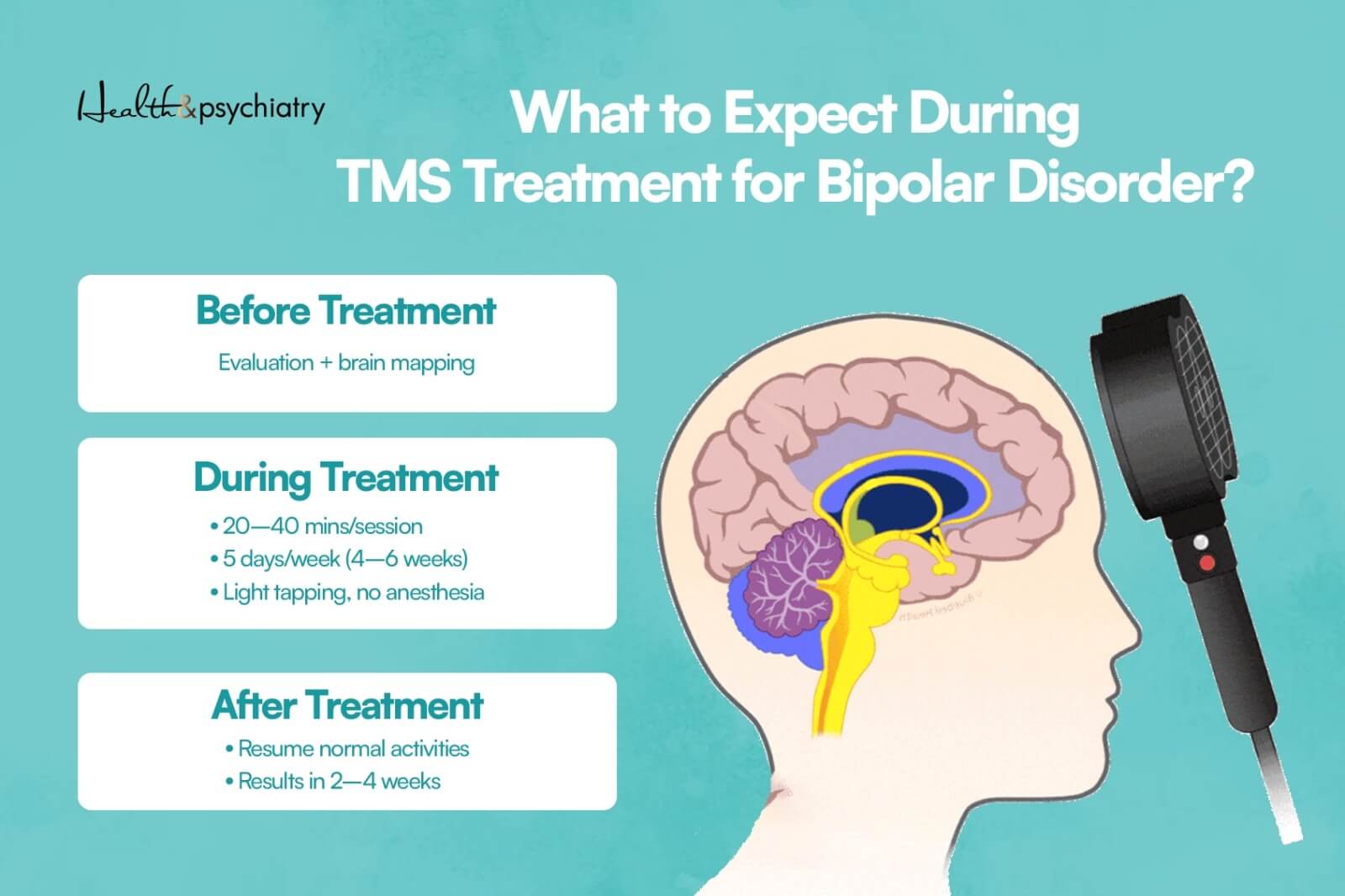
Patients are evaluated to qualify before they start using TMS. This involves medical history, medical medications, and the severity of the symptoms. The brain will also be mapped to show the exact area of stimulation by the treatment team.
→ During Treatment
A standard TMS treatment for bipolar disorder is approx. 20-40 minutes. This is done by having the patient sit in a chair and then a magnetic coil is placed on top of the head. The pulses are carried in short bursts, giving a tapping effect. Treatment is usually administered:
- 5 days a week.
- For 4–6 weeks.
There is no need for anesthesia and the patient is fully awake.
→ After Treatment
Most of them can resume normal activities immediately after every session. Patients start to experience improvements in 2 to 4 weeks usually, and some of them might take the entire course of treatment. Sessions of maintenance can be prescribed to maintain the results.
Side Effects and Considerations for TMS
TMS is mostly well-tolerated, but like any other medical treatment, it has some side effects.
The most frequent side effects are:
- Mild headache.
- Scalp discomfort.
- Tingling sensations.
They are normally short-lived, and they are solved soon after sessions. More severe risks are uncommon but could involve:
- Seizures (extremely uncommon).
- Mood switching (e.g., inducing hypomania in some infrequent cases).
There are some studies that have isolated instances of affective switching, yet no pattern has been found across the board.
It is also noteworthy that TMS is not a treatment in itself. The majority of patients keep taking the drugs and the treatment with them.
Start Your TMS Treatment in Florida with Health & Psychiatry!

When considering TMS treatment, it is imperative to identify a qualified provider. Health & Psychiatry in Florida offer individualized treatment programs, the development of TMS protocols, and qualified clinical staff.
By starting with us, you will get:
- Proper diagnosis and screening.
- Effective and safe delivery of treatment.
- Continuous monitoring and follow-up.
Dealing with mental health conditions is not easy but with the right healthcare provider, you can handle it.
We also offer virtual treatment services as telepsychiatry…
Book your appointment now!
FAQs
Does TMS treat bipolar?
TMS has not been approved by the FDA to treat bipolar disorder but major depressive disorder. However, it also has off-label applications in the treatment of bipolar depression.
Can TMS make bipolar disorder worse?
In uncommon instances, TMS can be followed by hypomania or mood switching. The majority of the studies. However indicate that it is usually safe in its proper usage.
Is TMS safe for bipolar disorder?
Yes, studies have shown that TMS is safe and well-tolerated, and there have been no serious adverse effects found in numerous clinical studies.
Should I discontinue medication when starting TMS?
No. TMS is not intended to be used as an alternative to medication. The changes in medications that need to be made are only the ones that are subject to medical supervision.