Cluster A personality disorders are often referred to as “odd” or “eccentric” and are prevalent among millions of people around the world.
People with these disorders often have distorted thinking. They suffer social discomfort and difficulty forming close relationships. You may feel their social detachment or be suspicious of others.
However, these disorders are common but are often under-talked about, underdiagnosed & misrepresented.
What are Cluster A Personality Disorders?

Personality disorders in cluster A are characterized by significant difficulty in functioning and/or relationship patterns that stem from a pervasive pattern of odd or eccentric thinking and behavior that deviates markedly from the norms of the culture.
While mood disorders and anxiety disorders occur by episode, personality disorders are long-term and pervade an individual's life. These tend to develop from middle to late teen years, and are a part of someone's thoughts and interactions with others.
The global systematic review of the prevalence of Cluster A personality disorders put the global prevalence at around 3.8 per cent, with Cluster C being the second most common cluster worldwide.
What Are the Main Types of Cluster A Personality Disorders?
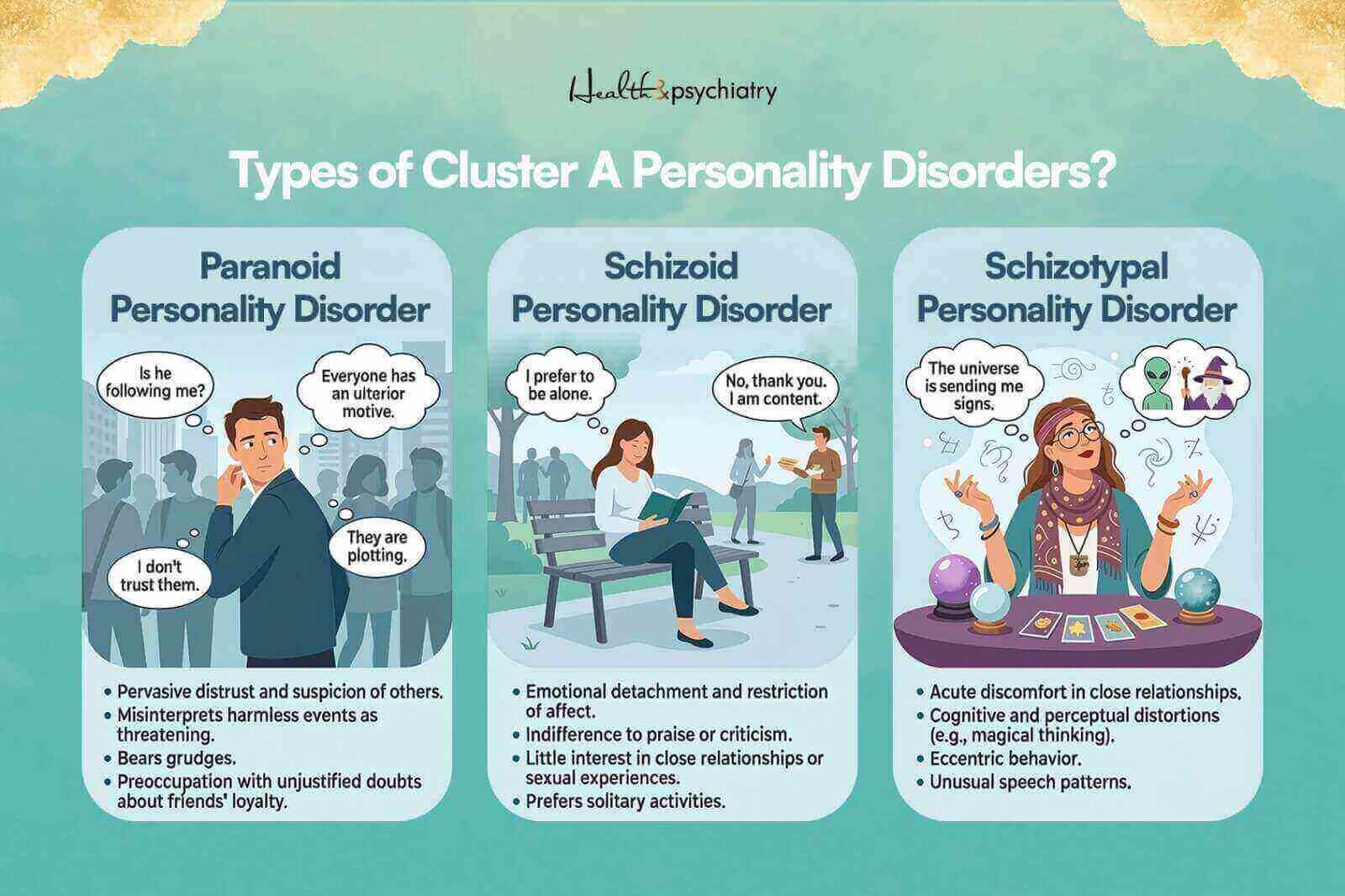
1. Paranoid Personality Disorder (PPD)
A pervasive pattern of unwarranted suspicion and distrust of others is unique to paranoid personality disorder. In someone with PPD, all the time there is a feeling of insecurity, where actions that are not intended to be felt as bad somehow feel bad or deceptive, or even worse.
Key personality attributes are:
- Long term, unreasonable fear that others are taking advantage of or lying to them
- Worrying that others will use the information against them, and so withhold trust and confidence from them.
- Interpretation of innocent statements in a threatening way
- Holding a grudge and unwilling to overlook or accept slighting/upset
- A disrespectful and confrontational attitude toward others
PPD can impact between 1.36% of adolescents and 2.3% – 4.4% of the general adult population. The disorder is thought to be associated with a dysfunctional amygdala, the area of the brain involved in the processing of fear and threat, genetic risk, and childhood trauma and/or unstable conditions.
2. Schizoid Personality Disorder (ScPD)
Schizoid personality disorder involves a lack of emotional connection and little to no desire to build relationships, including romantic relationships. Importantly, a person with ScPD doesn't feel lonely; they are not avoidant due to fear, but simply because there is no social appeal to them. Characteristics of key personality types are:
- Problems in close relationships, even those with relatives
- Choices and decisions about solitude activities
- Little interest in sexual experiences
- Lack of emotion and isolation
- Unaware of respect or disgust to praise or criticise
Schizoid personality disorders clusters prevalence is reported between 3.1% to 4.9% of the general population, and about equal in men versus women.
3. Schizotypal Personality Disorder (STPD)
Schizotypal personality disorder is the most closely related personality disorder to schizophrenia. Unlike schizoids, people with STPD are not confused by their perceptions; they do not live in fantasyland, but they are living in magical thinking and believe in highly unusual things:
- Magical thinking or unusual perceptions (such as reading hearts and forecasting)
- Ideas of reference, which are beliefs that meaningless events mean something personal to them.
- Beginning handedness, or other unusual perceptual experiences (e.g., feeling something present when it isn't)
- May have odd or eccentric speech or appearance
- An overwhelming need to conform in a very unusual way, stemming from paranoid fears instead of self-consciousness
While the median estimated prevalence is 0.6%, this could be as high as 3.9%, it is slightly more common in males. Research indicates that its constituents are primarily biological and genetic, with many of the same brain changes as seen in schizophrenia.
What Are the Symptoms of Cluster A Personality Disorders?
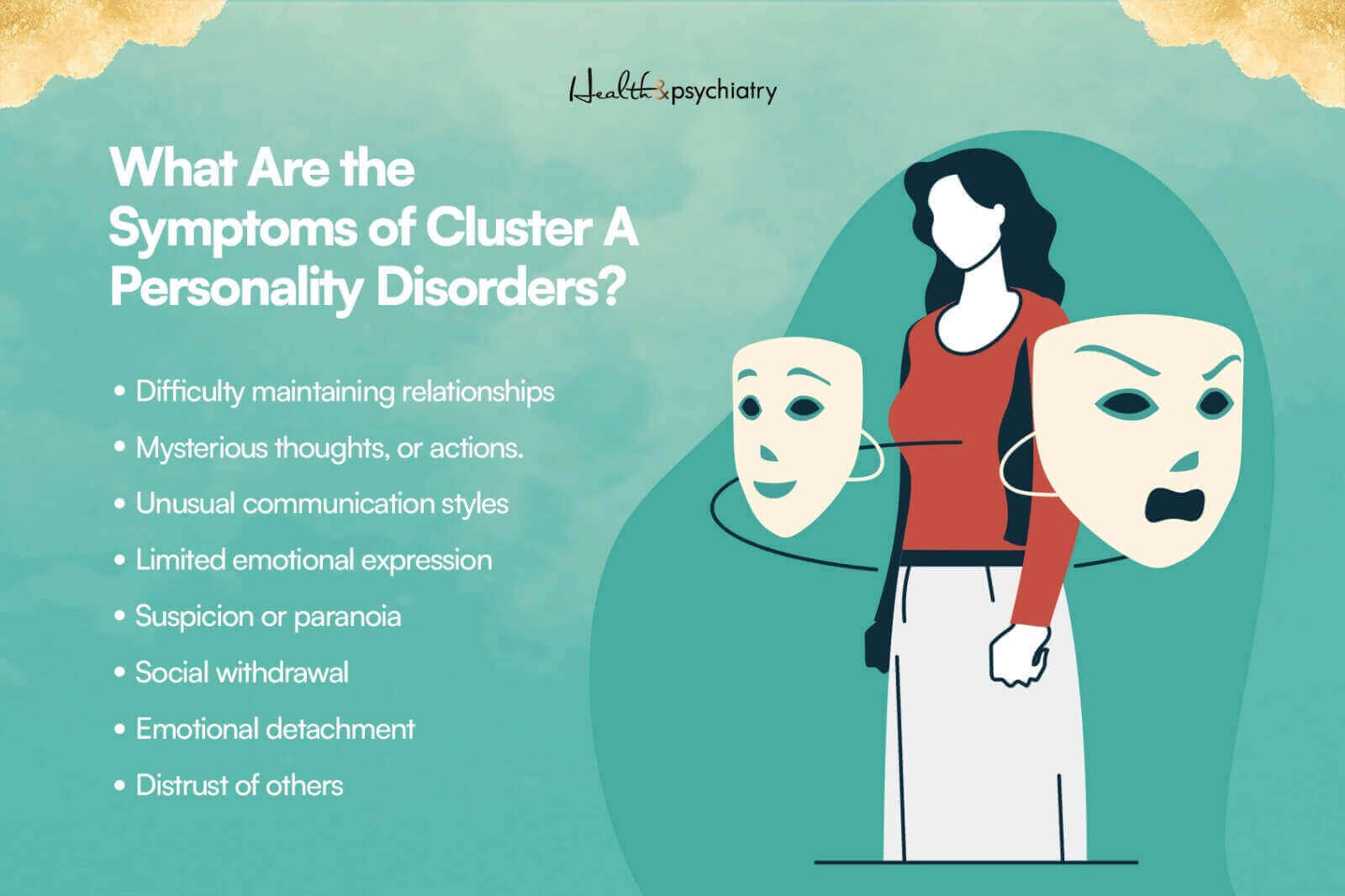
There are a number of common symptoms between disorders in the Cluster A (crisis-prone disorders).
Common cluster A personality disorder symptoms include:
- Social withdrawal
- Emotional detachment
- Distrust of others
- Mysterious thoughts, or actions.
- Difficulty maintaining relationships
- Unusual communication styles
- Limited emotional expression
- Suspicion or paranoia
Cluster A Personality Disorders Causes
These disorders do not have a single cause. These studies suggest that biological, genetic and environmental factors are all involved:
- Genetics: There is evidence for a common genetic architecture as to being more likely to be biological relatives of people with schizophrenia when compared with anyone else who might have cluster A personality disorders.
- Brain structure and function: Alterations in the functioning of the amygdala have been reported in studies of paranoid personality disorder; and the schizotypal personality disorder had measurable alterations in neurological functioning in a similar way to schizophrenia.
- Childhood environment: Various aspects of childhood environment were identified as risk factors, especially the emotionally cold, neglectful or emotionally detached parenting, especially in relation to developing schizoid personality disorder.
- Paranoia and withdrawal: In stressful childhood environments, children can become paralysed by fear and disconnect emotionally.
Clusters A Personality Disorders Diagnosis

Advanced Psychological Assessment by a qualified mental health practitioner is needed for the diagnosis of odd and eccentric personality disorders. Diagnostic statements are usually made using the DSM-5 criteria and symptom history, behavioral assessments, and/or interviews.
A health professional might consider the cluster A personality disorders test:
- Long-term behavior patterns
- Relationship difficulties
- Emotional functioning
- Family & Medical History
- Mental health disorders that may occur together
Symptoms of eccentric personality disorders are sometimes similar to those seen in anxiety disorders, depression, autism spectrum disorder or schizophrenia, so careful evaluation is necessary.
Treatment for Cluster A Personality Disorders
While it may be difficult to treat personality disorders, the majority of people get help and can receive cluster A personality disorders treatment over an extended period of time.
→ Therapy
Psychotherapy is the mainstay of treatment for disorders of Type A personality. Cognitive Behavioural Therapy is a usual approach in assisting people to recognize negative thought patterns and develop sound coping skills. There can also be enhanced emotional awareness, communication skills, and personal relationships functioning due to therapy.
Supportive psychotherapy may be useful to help the person feel more comfortable in social situations and relationships, as may social skills training.
→ Medication
Although most of the personality disorders in cluster A have no primary medical treatment, medications can be used to treat specific symptoms:
- Antipsychotics (atypical): Reduce feelings of anxiety and positive symptoms of schizotypal personality disorder
- Antidepressants: May decrease social anxiety and depression (common comorbidities); more than 50% of people who suffer from STPD have experienced at least one major depressive episode.
How to Cope With Cluster A Personality Disorders?
Treatment for Cluster A personality disorder includes following coping strategies:
→ Structured routines: This will help reduce anxiety and paranoia because of the lack of predictability.
→ Journaling: Can be of assistance to externalizing thoughts, allowing for the identification of patterns over time
→ Social exposure: For STPD patients, gradual social exposure can alleviate avoidance without overloading, via small and structured social interactions.
→ Creative outlets: Some schizoid people may need art, writing or music to emotionally process and be involved in a meaningful way.
→ Psychoeducation: Educating about the disorder lessens self-blame and affects family responses better than not knowing what is happening.
→ Mindfulness: May be helpful in regulating emotions, but could be introduced in therapy with caution due to how some Cluster A individuals perceive things, and because they can experience unusual things when operating this skill.
Risk Factors
There are a number of factors that might enhance the odds of acquiring Cluster A personality disorders.
- One of the clear stronger contributors is thought to be genetics, particularly among families with a history of schizophrenia-spectrum conditions.
- Risk can also be raised by childhood trauma, neglect, emotional abuse and a prolonged lack of social interaction.
When Should You Call For Professional Help?

Not all people with eccentric behavior and/or social preferences necessarily have personality disorders. However, some patterns can be considered seriously as they may result in regular trouble and impairment of daily functioning — particularly when experienced in a distressing way.
If you or someone you know has the following group A personality disorder symptoms, call for professional help:
- Has a strong belief in magic or perceives things in an abnormal way that seem real…
- Practices these behaviors since adolescence/early adulthood..
- Has difficulty keeping jobs, school, or getting work done on their own, due to these characteristics..
- Thinks people are out there to hurt them..
Get Treatment for Cluster A PD in Florida at Health & Psychiatry!
It is difficult to live with someone who has a Cluster A personality disorder. However, by undergoing the proper professional care and treatment, symptoms can be controlled and quality of life may be greatly enhanced.
Our licensed psychiatrists and mental health professionals are available to assist at Health & Psychiatry. Type a personality disorder, and all other personality disorders and related conditions can be assessed, with medication management. Our treatment plans with compassionate and confidential care are customized for you, with insurance support!
Reserve a consultation today for a same-week appointment with expert licensed providers … Remember! If you can change your mind, you can change your world!
FAQs
What disorders make up Cluster A?
Cluster A personality disorders list features those who are labeled as paranoid, schizoid and schizotypal. There are several characteristics that one would expect to see in these disorders: eccentric behavior, unusual behavior, and socially deviant behavior.
Is schizotypal personality disorder the same as schizophrenia?
No. Schizotypal personality disorder resembles schizophrenia, but is not regarded as the same illness. People with STPD can have abnormal thoughts or have minor, not serious perceptual changes, and usually do not have strong hallucinatory or psychotic behaviors like schizophrenia.
Do sufferers of Cluster A disorders have any meaningful relationships?
Yes. Despite some potential difficulties in relationships – arising from mistrust, emotional detachment or social discomfort – many people with Cluster A disorders are able to build meaningful personal relationships through effective communication and our therapies.